
Your Parental Leave Policy Is Not a Leadership Continuity Plan
Paid leave protects an employee’s ability to step away. A continuity plan protects the organization’s ability to let them.
A senior marketing leader announces she is taking 16 weeks of parental leave. Everyone responds exactly as they should: congratulations, we are thrilled for you, take the time, we’ve got this. HR moves quickly to confirm eligibility, dates, benefits, pay, paperwork, and return-to-work requirements.
The company has a parental leave policy. It does not yet have a plan.
That becomes clear when the operational questions start. Who has final say if the Q4 campaign misses its performance target? Who decides whether to move the product launch when Product and Sales disagree? What happens to the agency relationship she owns, the quarterly planning process she leads, or the strategic initiatives that depend on her judgment?
Then the harder questions surface. Which work should stop rather than quietly moving onto an already-full team? How much additional responsibility can her direct reports realistically absorb for four months? Who tells the executive team where decision authority now sits, and what happens when the leader returns and needs that authority back?
None of those questions mean the parental leave policy failed. They mean the policy was never designed to answer them.
Formal parental leave guidance appropriately focuses on eligibility, qualifying events, duration, pay, documentation, and administrative requirements. Those protections are essential, but they are categorically different from the operating decisions required when a leader steps away.
The policy answers whether someone can step away. A continuity plan answers whether the organization knows how to keep moving when they do.
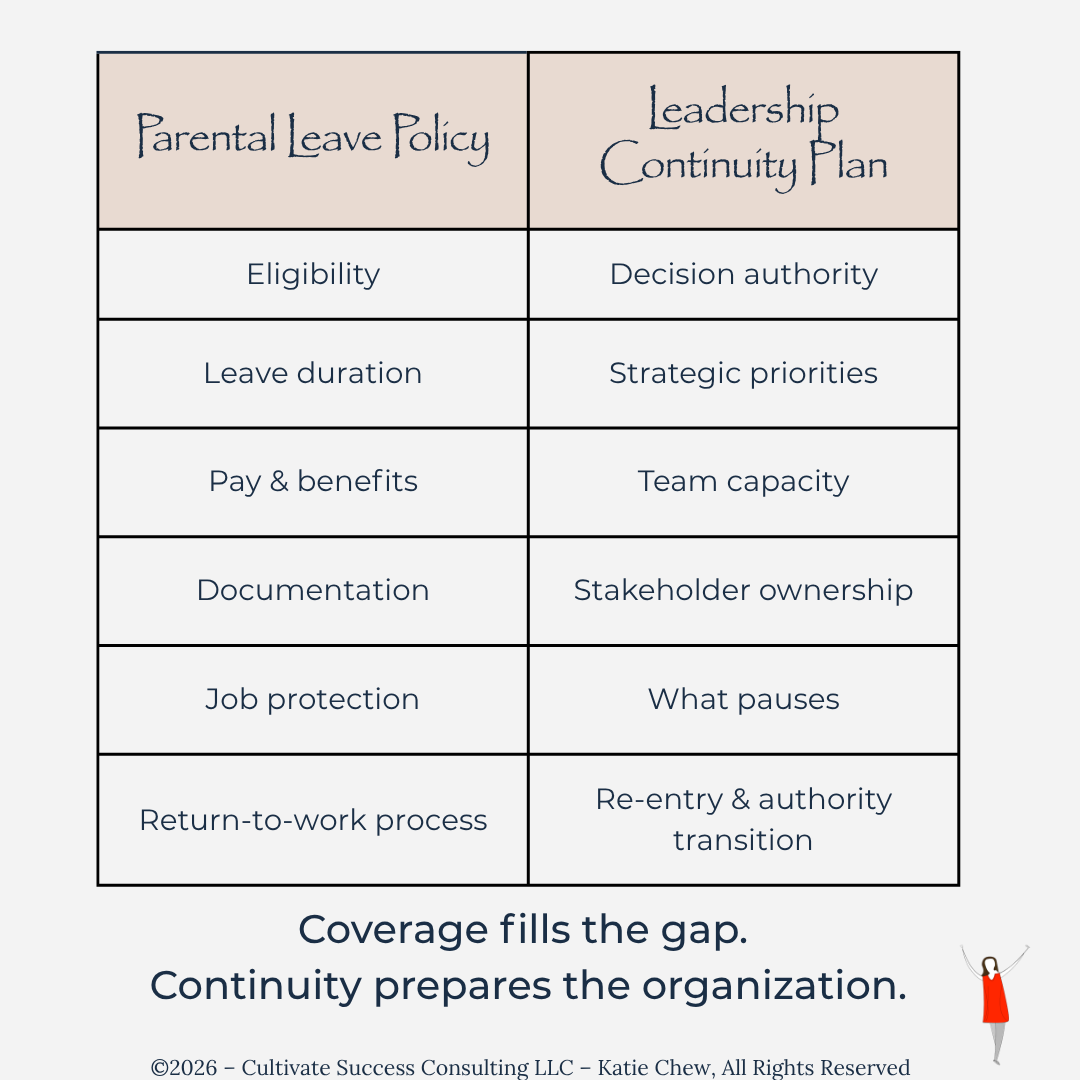
A side-by-side comparison showing the different roles of a parental leave policy and a leadership continuity plan. While the policy addresses eligibility, leave duration, pay and benefits, documentation, job protection, and administrative return, the continuity plan addresses decision authority, strategic priorities, team capacity, stakeholder ownership, what can pause, and re-entry. The visual reinforces the distinction that coverage fills the gap while continuity prepares the organization.
That distinction matters at every level of an organization, but it becomes especially consequential during leadership parental leave. The more decisions, relationships, context, and institutional knowledge someone holds, the less useful it is to think about their absence as a collection of tasks waiting to be reassigned.
A Parental Leave Policy Solves the Right Problem, Just Not the Whole Problem
Companies should protect and encourage parental leave. This is not an argument for treating leave as a business inconvenience that needs to be minimized; it is an argument for building organizations capable of supporting it well.
There is also a legitimate business case for doing so. BCG has cited research showing that women who take paid leave are 93% more likely to remain in the workforce nine to twelve months after childbirth than women who take no leave. BCG also reported that after Google increased paid maternity leave from 12 to 18 weeks, its post-leave turnover rate among new mothers fell by 50%.
Good leave policies matter. But the employee experience does not stop with the policy.
If an organization invests in giving employees meaningful time away but fails to prepare the business to operate without them, it creates unnecessary risk for everyone involved. The employee may spend the weeks before leave trying to personally solve every coverage problem. Their colleagues inherit additional responsibilities without clear tradeoffs. Leadership assumes the system is working because the deadlines are still being met.
This is where parental leave planning has to move beyond benefits administration. A policy can tell you who qualifies, how much time is available, whether the leave is paid, how benefits are handled, what paperwork is required, and how the employee formally returns. It generally will not tell you who can redirect a seven-figure media budget, renegotiate an agency scope, change a launch sequence, deprioritize a strategic initiative, or tell the CEO that something needs to wait.
Those are business decisions, and someone still has to make them.
HR owns the policy. Leadership owns the operating model.
HR should be an important partner in the transition, but HR should not be expected to redesign Marketing, Sales, Finance, Operations, or any other function every time a leader takes leave. The CEO, CMO, functional leader, and departing employee have to determine how authority, priorities, capacity, communication, and relationships will work differently while that person is away.
That is the difference between having a parental leave benefit and being organizationally prepared to use it.
Parental Leave Is a Leadership Transition, Not a Date Range
Most organizations naturally think about parental leave as a period on the calendar: Laura leaves May 1 and returns August 19, so we need coverage between those dates.
The transition is bigger than the absence.
Research from WorldatWork and the Center for Parental Leave Leadership frames parental leave across three deliberately managed phases: preparation before leave, the leave itself, and return and reintegration. Their recommendations include documented action plans, contingency planning, cross-training, communication protocols, and structured return conversations.
That framework matters because the business begins changing before the employee's last day. Responsibilities are transferred, stakeholders adjust, colleagues take on new roles, and decisions begin moving through different people. Those changes continue during the leave and have to be intentionally unwound, retained, or redesigned when the employee returns.
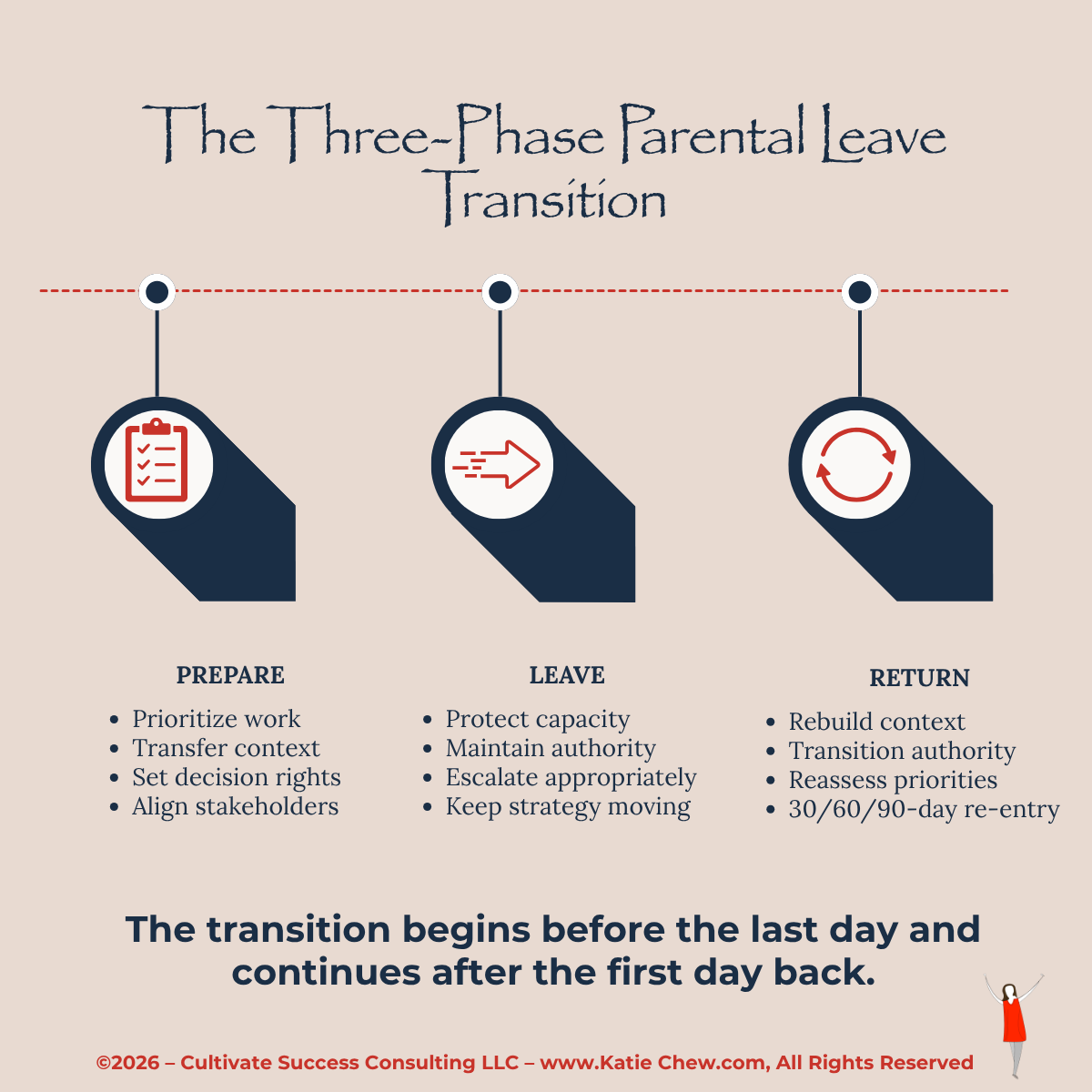
A three-phase view of leadership parental leave showing that effective transition planning extends beyond the employee’s actual time away. The Prepare phase focuses on prioritizing work, transferring context, establishing decision rights, and aligning stakeholders. The Leave phase protects capacity, authority, escalation, and strategic momentum. The Return phase rebuilds context, transitions authority, reassesses priorities, and supports a structured 30/60/90-day re-entry.
Thinking only about the absence encourages organizations to solve for temporary coverage. Thinking about the full transition forces leaders to ask whether the business, the team, and the employee are actually prepared for what changes before, during, and after leave.
That distinction sits at the center of The Continuity Method™. Most organizations prepare for the work; stronger organizations prepare the people, the team, and the business because the goal is not simply to survive an absence, but to protect momentum and leave the organization stronger than before.
Coverage fills the gap. Continuity prepares the organization.
Parental Leave Coverage Is More Than Naming an Interim Lead
One of the first questions leadership teams ask during parental leave planning is, “Who is going to cover?” That is a necessary question, but it becomes dangerous when it is mistaken for the whole plan.
A name on an org chart is not leadership continuity.
Task coverage means someone attends meetings, approves routine work, fields questions, and keeps projects moving. Leadership continuity means someone has the context, authority, capacity, executive backing, and mandate to make decisions when there is no obvious right answer.
Consider a VP of Marketing taking four months of parental leave. Campaign execution goes to the Director of Demand Generation, brand oversight shifts to the Creative Director, agency management moves to a senior marketing manager, and the CMO agrees to handle executive reporting. On paper, every major responsibility has an owner.
Then a campaign underperforms and $500,000 needs to move between channels. Product delays a launch and Sales wants Marketing to maintain the original demand plan anyway. The agency recommends a strategic change that affects both budget and brand positioning.
Who makes the call?
If the answer suddenly becomes “the CMO,” then the organization did not actually transfer leadership. It redistributed work while allowing decision authority to remain somewhere else.
That is the hidden leadership gap in many parental leave coverage plans. Senior leaders carry far more than visible deliverables; they hold institutional context, relationship capital, credibility, pattern recognition, and the authority to make tradeoffs when competing priorities cannot all win.
Redistributing the calendar does not redistribute judgment.
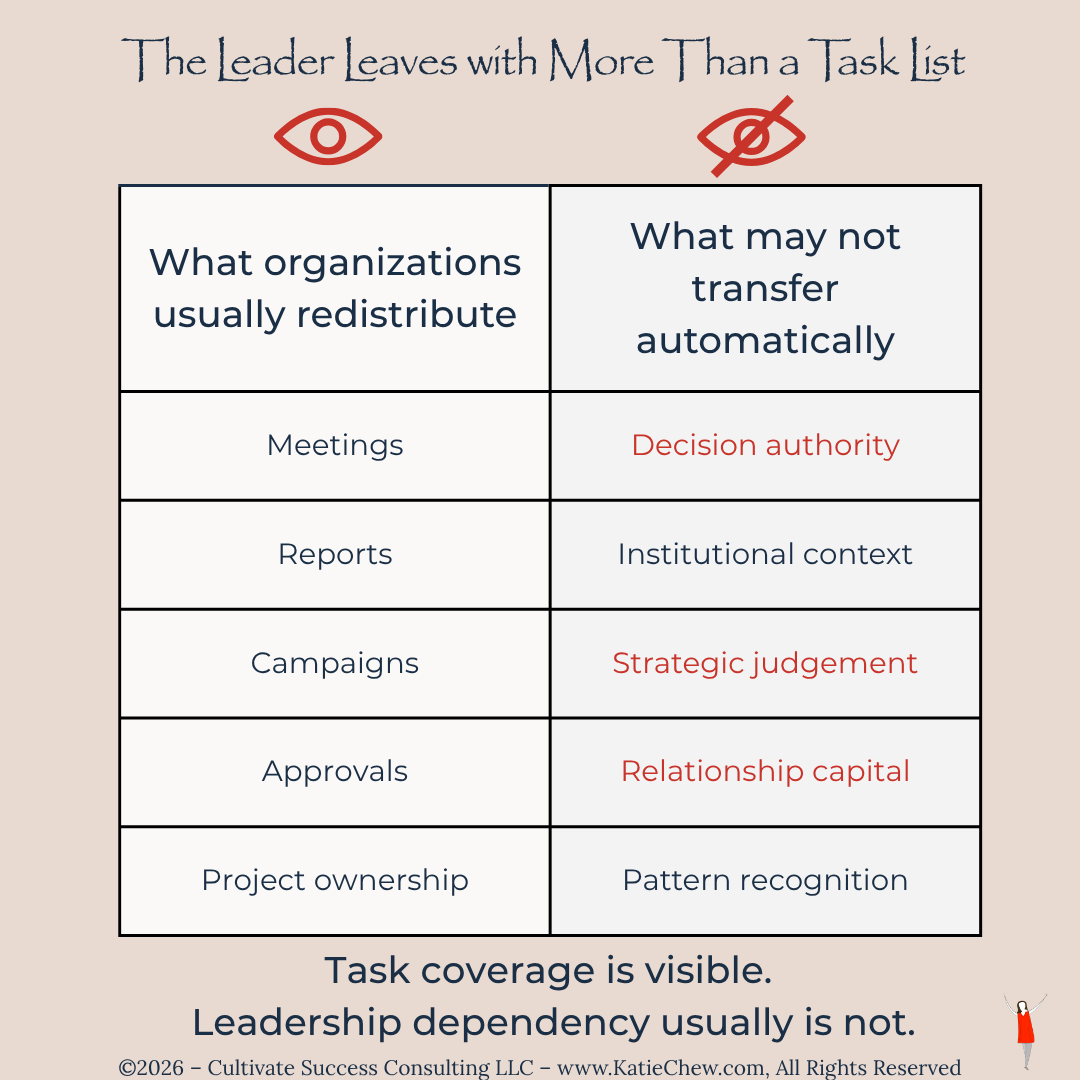
A comparison illustrating the difference between the visible work organizations can easily redistribute during leadership leave and the less visible leadership assets that do not transfer automatically. Meetings, reports, campaigns, approvals, and project ownership can be reassigned, while decision authority, institutional context, strategic judgment, relationship capital, and pattern recognition require intentional continuity planning.
The goal is not to recreate the absent leader through five other people. It is to determine what the organization needs in order to continue making good decisions without them, then explicitly give the appropriate people enough authority, context, and executive support to do it.
The Team Absorbs Whatever Leadership Refuses to Prioritize
Every responsibility the departing leader owns has to go somewhere. It can be delegated, delayed, reduced, automated, outsourced, or stopped.
There is no seventh option called “the team will figure it out.”
Unfortunately, that is how many parental leave coverage plans operate in practice. A high-performing manager takes over weekly reporting. Someone else picks up the agency relationship. Another employee assumes people-management responsibilities because it could be a useful development opportunity, and everyone agrees they can stretch for a few months because they genuinely want to support their colleague.
For a while, it works. The campaigns still launch, the reports still arrive, and nobody walks into the executive meeting announcing that the team is slowly running out of road.
That is precisely why this risk is easy to underestimate.
Gallup found that 23% of full-time employees reported feeling burned out very often or always, while another 44% experienced burnout sometimes. Employees experiencing frequent burnout were 63% more likely to take a sick day and 2.6 times as likely to be actively seeking another job. Gallup also identifies unmanageable workload, unclear communication, lack of manager support, and unreasonable time pressure among the conditions associated with burnout.
Those numbers do not mean parental leave causes burnout. They do tell us why transferring months of additional responsibility to an already-full team without revisiting workload, priorities, staffing, authority, and expectations is a questionable management strategy.
I have written before that performance without slack is fragility. A team that performs beautifully only when every person is present, healthy, engaged, and operating at full capacity is not as resilient as the dashboard suggests; an extended absence simply reveals the dependency that was already built into the system.
This is where executives need to ask a harder question than, “Can the team handle it?”
High performers can handle a lot. That is often how organizations get themselves into trouble.
Ask what the team will stop doing in exchange.
If a director is taking on 25% of their leader’s responsibilities for four months, something should change in their existing scope. If nothing is being removed, reduced, delayed, or resourced differently, leadership has not solved the capacity problem. It has simply transferred it.
Interim Authority Has to Be Real Authority
When a leader takes parental leave, their manager or executive sponsor becomes one of the most important people in the transition. Not because they should absorb the absent leader’s job, but because they have to legitimize the temporary operating model.
You cannot delegate accountability and withhold authority.
Imagine a Director is named interim marketing lead. Inside Marketing, everyone understands that she is responsible for keeping strategy and execution moving, but Sales was never told what authority she has, Finance continues escalating decisions directly to the CMO, and the agency still emails the absent VP when something feels important.
Then the interim leader makes a difficult call and the executive team quietly reverses it.
She technically owns the role. Operationally, she owns nothing.
The consequences appear quickly. Stakeholders start bypassing her, team members wait for executive confirmation before acting, decisions creep upward, and the interim leader becomes responsible for results she does not have enough authority to produce.
That is not an interim-leader failure. It is an executive sponsorship failure.
Managers already play an outsized role in employee engagement and clarity. Gallup has repeatedly found that managers account for roughly 70% of the variance in team-level engagement, which makes the behavior of the manager or executive sponsor particularly important when the normal leadership structure is temporarily disrupted.
During leadership parental leave, authority has to be explicit, visible, and reinforced. The team needs to know who can decide. Cross-functional partners need to know whose answer counts. Executives need to resist the temptation to undermine the structure every time they would have made a different call.
Otherwise, coverage becomes theater.
The Return Is Part of the Plan, Not the End of It
Organizations will spend weeks planning how a leader steps away and surprisingly little time planning what happens when that person comes back.
The return is not when the transition ends. It is another transition.
Four months is plenty of time for priorities to shift, relationships to evolve, new processes to emerge, and employees to grow into responsibilities they did not previously own. Some of those changes should revert when the leader returns. Others may be improvements worth keeping.
The returning leader has changed too. They are coming back with months of missing context and, in the case of parental leave, a completely different personal reality than the one they left with.
Expecting everyone to arrive Monday morning and reset the organizational clock to the day before leave began ignores both sides of that equation.
WorldatWork recommends treating return as a distinct phase that requires adjustment and reintegration rather than assuming an immediate return to the previous normal. That is also why Design the Return is part of The Continuity Method™: successful re-entry requires updated context, clear priorities, authority transition, communication, and a deliberate plan for the first 30, 60, and 90 days.
Without that structure, returning leaders often enter recovery mode. They are trying to understand four months of decisions, reclaim responsibilities, repair anything that drifted, support a team that may be tired, rebuild stakeholder context, and simultaneously perform the job they just returned to.
That is not re-entry. That is organizational debt collection.
A continuity plan determines before leave how information will be captured, how the returning leader will be briefed, which responsibilities transition back immediately, which should wait, and how temporary authority will be handed back without creating confusion or diminishing the people who stepped up.
Planning the return protects the leader. It also protects the team from yet another abrupt operating-model change.
Your Leave Benefit Is Also a Retention Investment
Paid parental leave can strengthen retention, morale, productivity, and talent attraction. That is part of the reason organizations have invested so heavily in improving parental benefits.
But employees experience systems, not policy PDFs.
A generous policy cannot compensate for a transition where the employee spends the month before leave frantically trying to make themselves replaceable, their colleagues spend four months drowning in additional work, and everyone expects the returning parent to restore normal operations within 48 hours.
That experience communicates something about the organization too.
BCG's research makes the business case for paid family leave partly through retention and replacement costs. Patagonia provides another useful example: the company reported a 100% return-to-work rate among mothers after maternity leave over a five-year period and lower turnover among employees using its childcare program.
The point is not that every organization needs Patagonia's childcare model. The more useful lesson is that employee support becomes a competitive advantage when it is treated as infrastructure rather than a symbolic benefit disconnected from how work actually gets done.
That distinction matters for CEOs, CMOs, and People leaders because retention is not owned by one function. HR may design an excellent benefit, but the employee's manager, executive team, colleagues, and operating environment determine whether the lived experience supports the promise.
Benefits communicate your values. Transitions reveal them.
The Five Questions Every Leadership Parental Leave Plan Should Answer
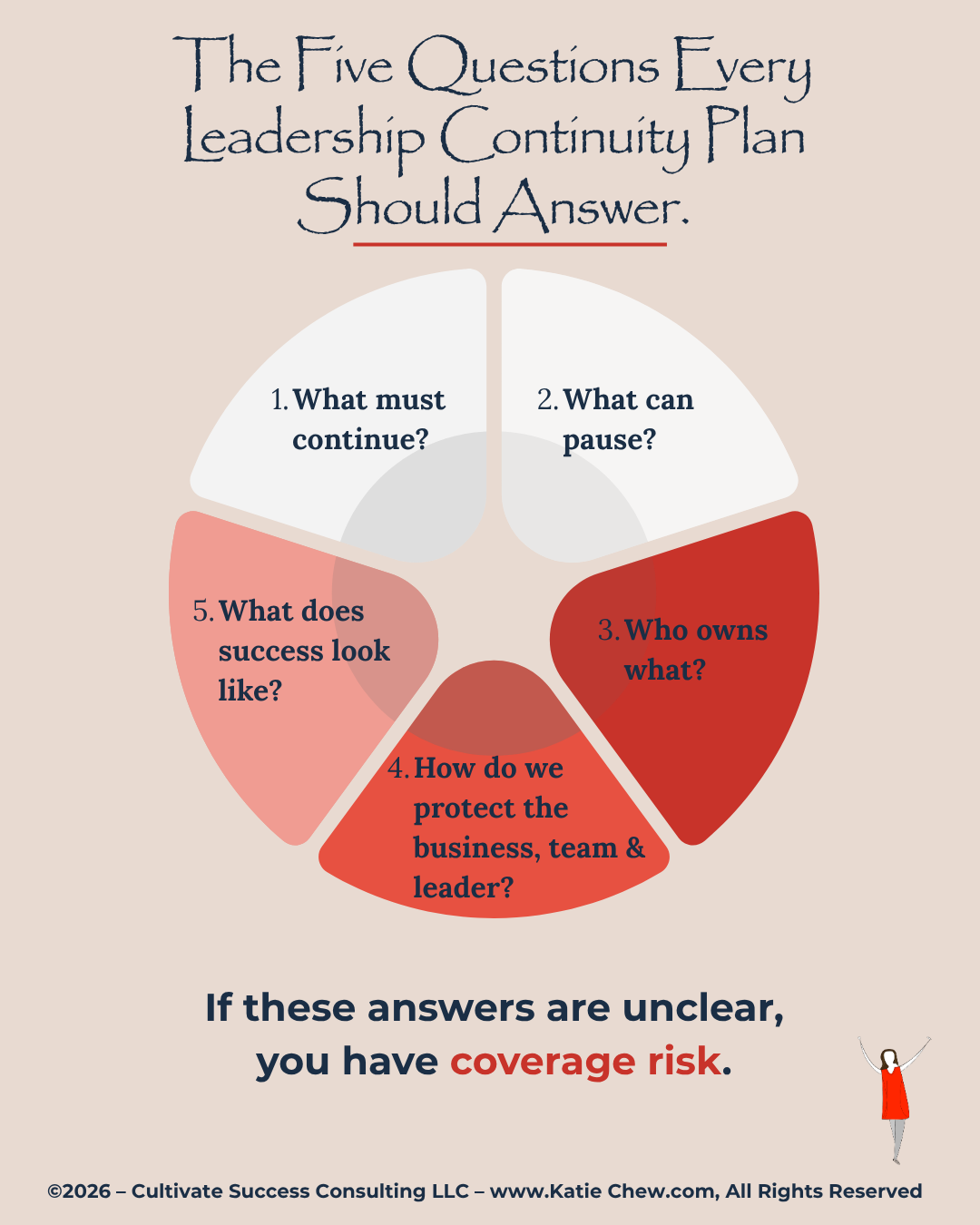
A five-part leadership continuity framework highlighting the questions organizations should answer before a leader steps away: what must continue, what can pause, who owns what, how the business, team, and leader will be protected, and what success looks like. The visual helps leaders identify gaps in parental leave coverage before those gaps create operational risk.
A leadership continuity plan does not need to become a 47-page binder that gets lovingly formatted, stored in SharePoint, and never opened again. It needs to be short enough to use, specific enough to govern real decisions, and agreed upon before the leave begins.
1. What absolutely must continue?
Identify the work, relationships, decisions, and priorities that genuinely protect business momentum. Depending on the role, that might include revenue-critical initiatives, strategic planning, major launches, customer relationships, agency leadership, executive reporting, people management, high-risk approvals, or important cross-functional dependencies.
Not everything deserves equal protection.
This exercise forces leadership to distinguish the work that truly matters from work that continues largely because nobody has challenged it. That clarity becomes even more important when the organization temporarily has less leadership capacity available.
2. What can safely pause?
This may be the most important question in the entire plan because it forces leadership to acknowledge a basic constraint: you cannot remove a senior leader for four months, maintain every existing priority, add their responsibilities to other people, and pretend nothing has changed.
Something has changed.
Determine what can be delayed, reduced, simplified, automated, outsourced, or stopped. Making those tradeoffs explicitly is not lowering standards; it is preventing employees from having to make them invisibly while carrying workloads leadership never formally acknowledged.
3. Who owns what while the leader is away?
Go beyond assigning tasks. Define responsibility, accountability, decision authority, escalation paths, budget thresholds, stakeholder ownership, and communication expectations.
Then tell people.
Marketing may understand the interim structure perfectly while Sales, Product, Finance, agencies, or customers continue behaving as though the absent leader is the only person whose answer counts. A continuity plan has to govern the broader network around the role, not merely the people who report into it.
4. How will we protect the business, the team, and the leader?
Look for risk across all three, because optimizing one at the expense of the others is how organizations end up with technically successful leaves and messy consequences six months later.
Where does institutional knowledge sit with one person? Where is the team already operating near capacity? Which relationships are overly dependent on the departing leader? What support will the interim lead need, and what boundaries will protect the employee on leave from becoming an unofficial consultant whenever something gets uncomfortable?
The objective is not simply uninterrupted output. It is to protect business momentum, strengthen the team, and support the person, which are the three outcomes at the center of The Continuity Method™.
5. What does success look like for everyone?
Define it before leave begins.
For the business, success may mean maintaining specific strategic priorities and performance thresholds. For the team, it might mean delivering fewer priorities without sustained overtime. For an interim leader, it may mean having genuine authority and a meaningful development opportunity.
For the person taking leave, success includes being able to actually take leave without functioning as the emergency hotline from the nursery.
And success needs a definition for the return too. If nobody can describe what a healthy first 30, 60, and 90 days back should look like, one of the most consequential phases of the transition is still being left to chance.
These five questions are the foundation of the Leadership Transition Map™, a practical planning tool designed to identify what must continue, what can pause, where ownership and decision rights shift, which relationships need proactive attention, and what should transition back after the leader returns.
One Page That Can Prevent Months of Confusion
For leadership parental leave, I would add one more tool to the plan: a decision-rights map.
This does not need to be complicated. A one-page document can establish which decisions the interim leader owns independently, which require executive consultation, which are reserved for the executive sponsor, what budget or contract thresholds apply, and which decisions can reasonably wait for the returning leader.
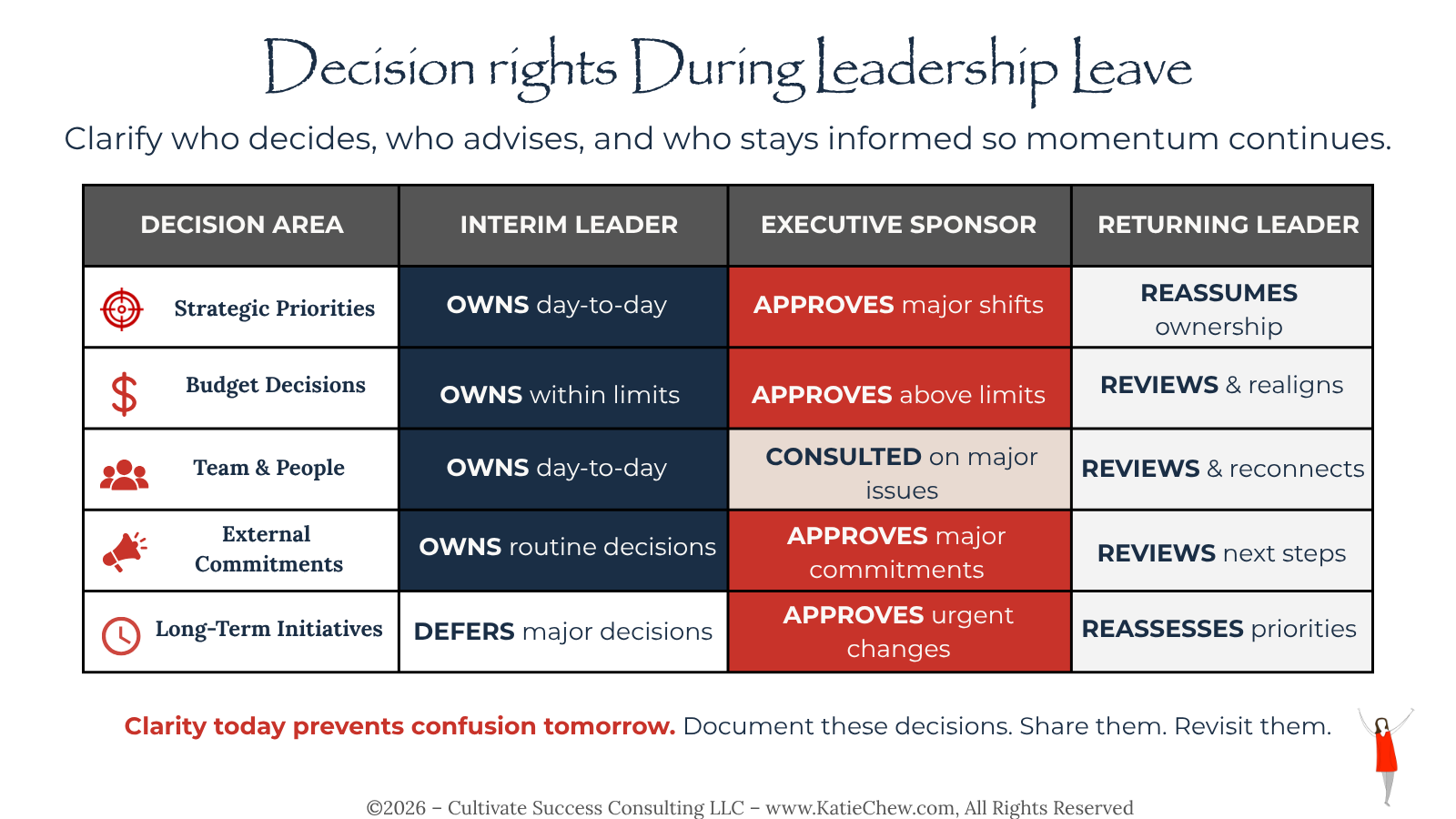
A leadership parental leave decision-rights matrix showing how authority can be distributed across an interim leader, executive sponsor, and returning leader. The example defines responsibility for strategic priorities, budgets, team and people decisions, external commitments, and long-term initiatives so organizations can establish clear ownership, escalation, and authority transfer before leave begins.
It should also define crisis and reputational-risk protocols. If something unexpected happens, the team should not discover in real time that nobody knows who is allowed to make the call.
The goal is not to replicate the absent leader.
The goal is to give the people who remain enough authority, context, and clarity to operate without paralysis, politics, back-channel escalation, or a steady stream of “quick questions” to someone who is supposed to be on leave.
That one distinction changes the quality of parental leave coverage dramatically.
Your Policy Makes Leave Possible. Continuity Makes It Work.
Parental leave should be ordinary, protected, supported, and genuinely usable. The leadership challenge is not whether employees should be allowed to step away; it is whether the organization has built a system capable of functioning when they do.
A parental leave policy tells employees they are entitled to step away. A leadership continuity plan proves the organization is prepared to let them.
The distinction is operational, cultural, and commercial. Organizations that manage leadership parental leave well do more than survive a four-month absence: they clarify decision-making, distribute institutional knowledge, expose fragile dependencies, develop emerging leaders, protect team capacity, and create a better return experience.
That makes parental leave planning something bigger than an HR process. It becomes a test of how resilient the organization actually is when one of the people holding the system together temporarily steps away.
And that is why coverage alone is not enough.
Coverage fills the gap. Continuity prepares the organization.
Life happens. Great organizations prepare for it.
Start by Mapping the Transition
If a leader in your organization is preparing for parental leave, start with the Leadership Transition Map™. It will help you identify what must continue, what can pause, where ownership needs to shift, which decisions require explicit authority, which relationships need attention, and what should transition back when the leader returns.
If the Map exposes gaps you are not sure how to solve, that is what the Leave Transition Intensive is designed for. We will pressure-test the transition, identify what requires attention now, and create a practical path forward before a manageable leave becomes an avoidable leadership problem.
Because your employee should be able to take the leave your policy promises.
Your organization should be ready to let them.