
How to Prepare Your Marketing Team for Parental Leave Without Losing Momentum
A 6-Step Framework for Protecting Revenue, Retention, and Team Stability
The Moment That Changes the Equation
There is a moment most marketing leaders recognize immediately, even if they have never articulated it out loud.
It happens in a one-on-one conversation when a trusted team member shares that they are preparing to take parental leave. The initial response is exactly what you would expect from a thoughtful leader. You are supportive, encouraging, and aligned with the kind of culture you are working to build.
At the same time, another layer of thinking begins to run quietly in parallel: What’s going to break while they’re gone, and how long until it’s noticed?
You start scanning your roadmap, not out of panic but out of pattern recognition. Upcoming campaigns, revenue targets, cross-functional dependencies, and the invisible connective tissue that holds your marketing organization together all come into focus. You think about how much context this individual carries, how often they make decisions that are never formally documented, and how frequently they serve as the bridge between strategy and execution.
And eventually, another question surfaces:
How do we keep everything moving without putting the business or the team at risk?
Most leaders do not say that part out loud. But it is the question that shapes every decision that follows.
Why Most Parental Leave Plans Fail in Marketing Teams
Many leaders don’t have a clear parental leave marketing strategy, although their teams move quickly into planning mode. Responsibilities are reassigned, timelines are adjusted, and coverage plans are created with careful intent. On paper, these plans often appear comprehensive. Every task has an owner. Every deliverable has a timeline. The system looks intact.
The assumption is straightforward. If the work continues and deadlines are met, the organization will remain stable.
But marketing organizations do not run on task completion alone. They rely on context, judgment, relationships, and leadership clarity. When those elements are not intentionally accounted for, even strong teams begin to experience friction that is difficult to detect early but costly over time.
Campaigns still launch. Reports are still delivered. Meetings continue.
From the outside, everything appears to be working.
Internally, however, the system begins to feel heavier.
When “Nothing Breaks,” But Everything Slows Down
I have seen teams navigate parental leave transitions where nothing technically failed. There were no missed launches, no major performance drops, and no visible breakdowns in execution. By most external measures, the transition would have been considered successful.
Inside the team, the experience was different.
Decision-making slowed because fewer people held full context. Conversations became more cautious because ownership was less defined. Team members spent more time validating their thinking rather than acting on it, which introduced a steady drag on momentum that no dashboard would immediately capture.
Nothing collapsed. But the system was no longer operating with the same level of clarity or confidence.
That distinction is where most of the long-term impact begins.
The Data Makes the Risk Impossible to Ignore
This is not simply an operational inconvenience. The data around parental leave transitions points to a much larger issue, and it is one most organizations underestimate until they are already dealing with the consequences.
The pattern becomes even clearer when you look at how quickly that risk develops, according to research from Parentaly’s 2024 study of working mothers and the 2026 Future of Working Motherhood Report:
One-third of employees leave within 18 months of returning
Nearly three-quarters report that they have considered leaving
The majority of exits occur within the first year, often within months
Up to 40% leave their roles within a year of having a child
These are not edge cases. They represent a consistent pattern. The timing of that attrition matters just as much as the volume.
Most organizations assume that if an employee returns from leave, the risk has passed. In reality, the opposite is true.
Return does not resolve the risk. It begins the most vulnerable phase.
The highest failure point is not the leave itself. It is the reentry and the months that follow.
Coverage vs Continuity in Marketing Leadership
Most organizations respond to parental leave by solving for coverage. They ensure that tasks are reassigned and that deadlines remain intact. While this approach is necessary, it is incomplete.
Coverage answers the question: who is doing the work?
Continuity answers a different question: what needs to remain stable for performance to hold?
Without continuity, even the best coverage plans create strain. Decision-making slows, ownership becomes diluted, and teams begin to compensate for gaps that were never formally addressed. Over time, that compensation turns into overextension, and overextension rarely resolves itself without consequences.
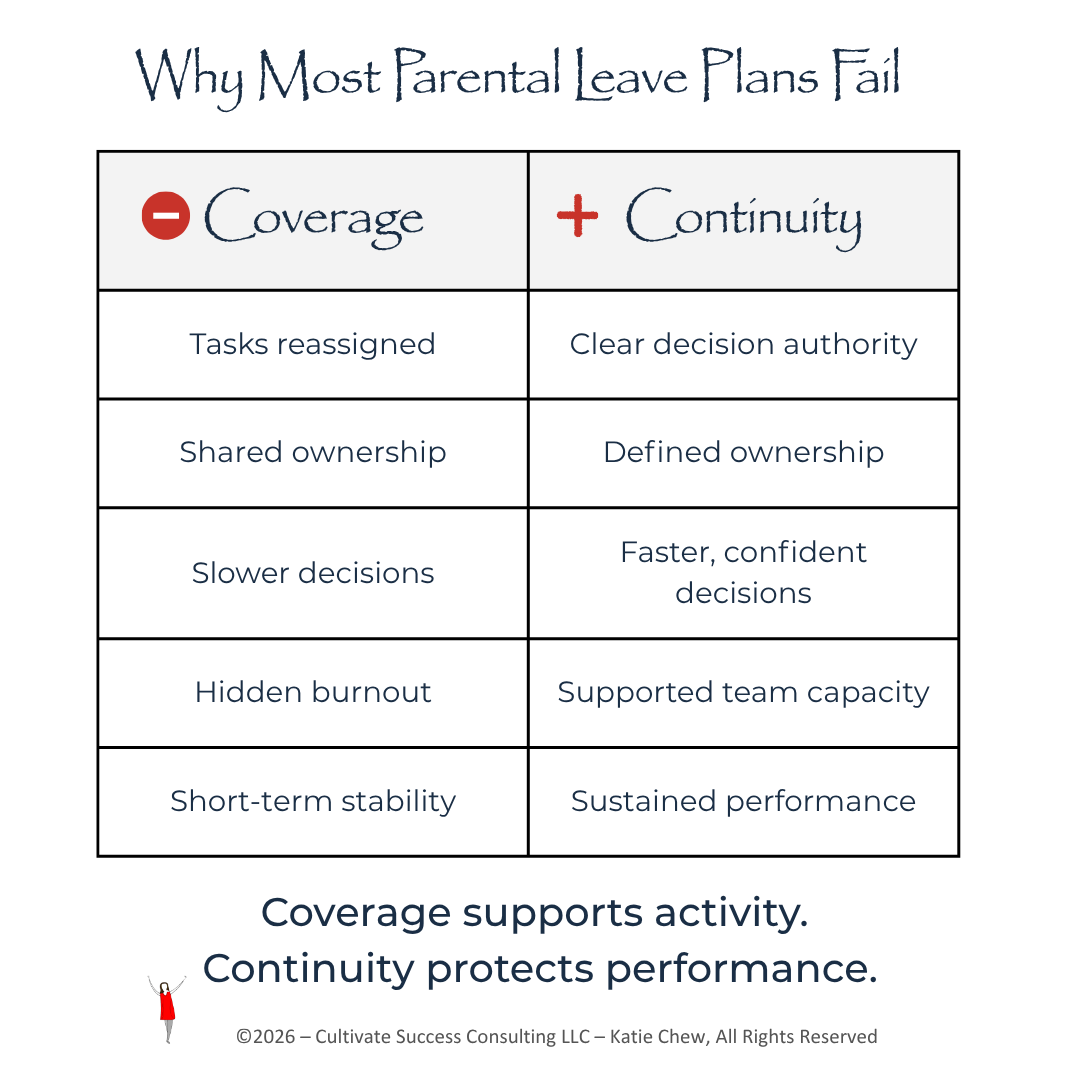
This visual compares traditional task coverage with leadership continuity in marketing teams, highlighting how clear ownership and decision-making improve performance during parental leave transitions.
Most teams plan for coverage. High-performing teams design for continuity.
The CONTINUITY Method™ for Marketing Teams
The gap most organizations encounter is not a lack of effort. It is a mismatch between what they plan for and what actually needs to remain stable.
Most teams plan for coverage.
Very few design for continuity.
That distinction is the difference between short-term stability and long-term performance.
The CONTINUITY Method™ is a six-part framework designed to maintain strategic clarity, protect team capacity, and stabilize performance during parental leave transitions. Rather than focusing solely on task redistribution, it addresses the full system that enables marketing teams to operate effectively. A structured parental leave marketing strategy ensures continuity.
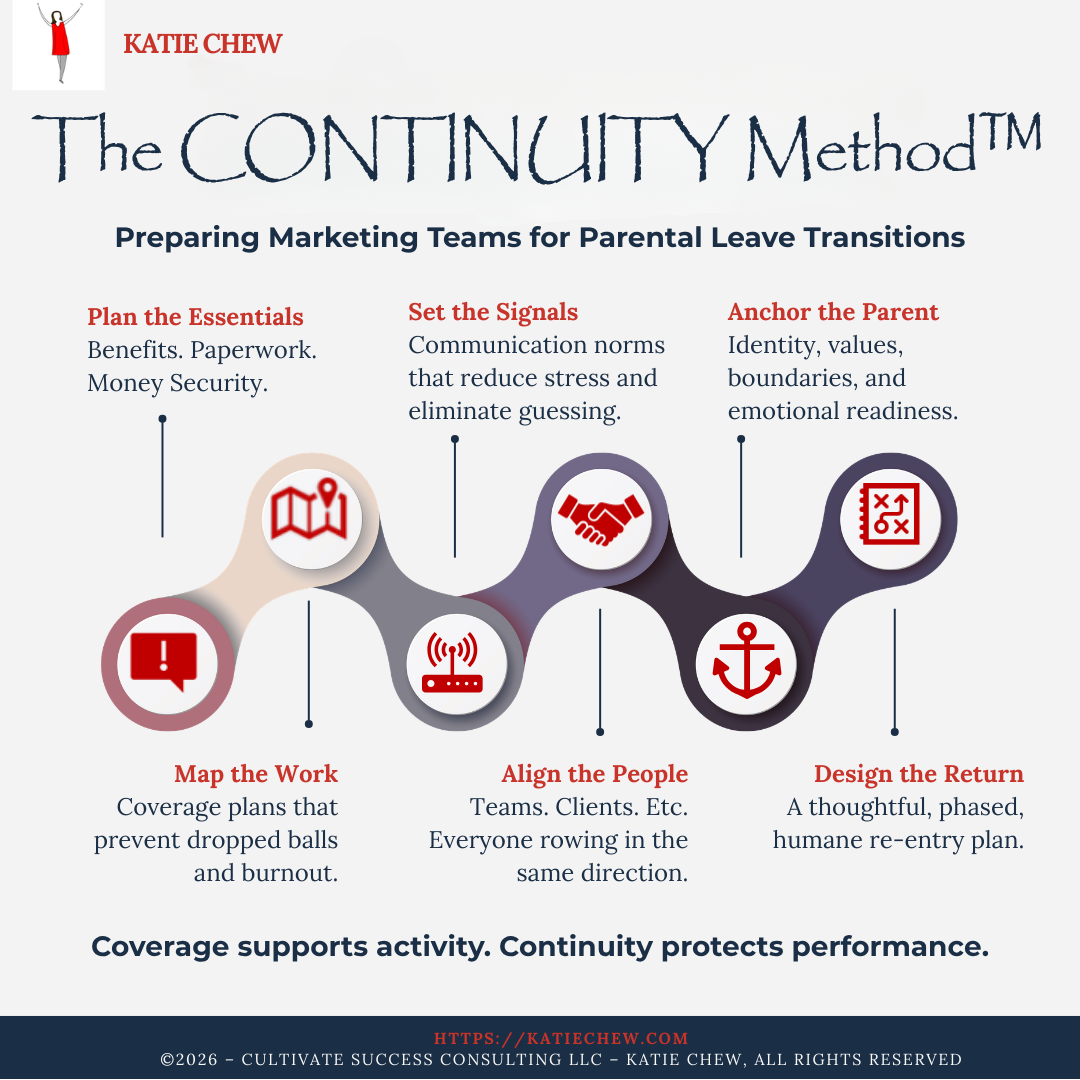
A six-step framework outlining how marketing teams can maintain strategy, communication, and performance before, during, and after parental leave by focusing on continuity rather than task coverage.
How to Plan Parental Leave for Your Marketing Team (6 Steps)
1. Plan the Essentials: Establish Stability Before the Transition Begins
The first phase is often treated as administrative, but it directly shapes how the entire transition unfolds.
Clarity around compensation, benefits, policies, and expectations determines whether the employee approaches leave with confidence or uncertainty. When this information is inconsistent, it introduces stress that extends into team dynamics and transition planning.
When handled well, it creates a stable starting point. The employee prepares for leave with clarity, the team sees that leadership has thought through the experience holistically, and unnecessary friction is removed early.
This is not about compliance. It is about trust. You begin to build that trust when you clarify the foundation.
2. Map the Work: Identify Where the System Relies on Individuals
Most teams approach this step by documenting tasks. That is necessary, but it only scratches the surface of how work actually flows through the organization.
The more important question is where your system depends on individuals rather than structure. In many marketing organizations, key leaders are not just executing work. They are interpreting data, prioritizing initiatives, and making judgment calls that guide direction. These contributions are often invisible until they are no longer present.
When one of those individuals steps away, redistributing tasks does not replace what they were providing. It simply redistributes activity without preserving decision-making clarity.
To organize the work effectively, you need to understand where decisions are made, how priorities are set, where critical context lives, and what happens when something unexpected occurs. This reveals not just what needs to be done, but what needs to remain stable.
Without that clarity, you are not redistributing work. You are fragmenting decision-making. This is not about task management. It is about protecting momentum by organizing the work and the decision-making.
3. Set the Signals: Remove Ambiguity from the System
Unclear communication is one of the fastest ways to create friction during a transition.
When expectations are undefined, teams are forced to interpret what is appropriate. Some over-communicate, seeking validation. Others under-communicate, attempting to avoid disruption. Both patterns slow execution and increase cognitive load across the team.
Clear communication structures eliminate that ambiguity. Defined update rhythms, escalation paths, and communication channels allow the team to operate with confidence and speed. This is both for the teams remaining at the organization as well as the leader away on leave.
This is not about adding layers of process. It is about setting boundaries and expectations. Normalizing communication patterns of who and how to contact the right people when the needs arise.
4. Align the People: Protect the Network That Drives Performance
Marketing performance depends on relationships that extend beyond the immediate team. Agencies, stakeholders, and cross-functional partners all play a role in maintaining momentum.
When a key leader steps away without clear alignment, these relationships can become points of instability. Partners may hesitate to act without clear direction. Internal stakeholders may question priorities. Teams may spend time managing perception instead of focusing on outcomes.
I have seen situations where agencies paused progress because decision authority was unclear. Internal stakeholders began seeking answers through alternate channels, creating confusion and duplication of effort. The team shifted focus from execution to managing perception. No single issue was catastrophic and nothing broke in a visible way. But collectively, they weakened trust and slowed progress.
Alignment requires proactive communication and clearly defined ownership. It ensures that every part of the system continues to function cohesively, even in the absence of a key leader.
This is not about coordination. It is about continuity which is maintained when you transition relationships.
5. Anchor the Parent: Support the Individual Behind the Role
Parental leave is not purely operational. It is a personal transition that affects how an individual relates to their work, their team, and their long-term trajectory. The individual stepping away is navigation changes that extend beyond their role. Their identity, priorities, and daily life are shifting. Ignoring this reality does not simplify the process. It makes reentry more difficult.
When organizations acknowledge and support this transition, they create a more sustainable experience. The employee remains connected to their role and their long-term trajectory, and they return with greater clarity and confidence. When a leaders return from leave is supported, the transition becomes more sustainable for everyone involved.
Supporting people effectively is not separate from performance. It directly influences it. This is not about over-accommodation. It is about long-term retention. You strengthen the retention when you integrate the human experience.
6. Design the Return: The Phase That Determines Retention
The final phase of the CONTINUITY Method™ focuses on what happens after the employee returns, which is where the majority of long-term outcomes are determined.
This is where most organizations make their most expensive mistake. They assume the system will naturally reset once the individual is back.
In reality, the return is its own transition.
Without a structured approach, returning employees often experience a gap between the system they left and the one they reenter. Priorities have shifted, relationships have evolved, decisions have been made without their context, and the team may be operating under strain.
In these situations, the returning leader frequently steps into recovery mode, attempting to stabilize the system while also adjusting to a new personal reality. This is where disengagement begins and where many eventual resignations take root.
When a return is designed intentionally, the experience looks different. Employees receive clear updates before they return, defined priorities for their first weeks back, and structured checkpoints that support reintegration. The system remains stable, and the individual can step back into leadership rather than repair.
This is where retention is most often won or lost. You protect retention when you navigate the return and structure reentry.
A Real Example of Marketing Team Transition Planning
A mid-size B2B company came to me after attempting to manage parental leave internally for their Director of Marketing.
On paper, their plan was solid. Responsibilities were redistributed, agency partners were informed, and leadership believed the system would hold.
For the first three months, it did.
By month four, the strain became visible beneath the surface.
Campaign timelines extended by 20%-30%
Pipeline contribution from marketing dropped by 18%
Two team members absorbed expanded roles without backfill
One of those employees resigned within six months of the leader’s return
The cost of replacing that employee alone exceeded $120,000 when factoring in recruitment, onboarding, and lost productivity.
During a subsequent leave, the company implemented structured interim leadership aligned with the CONTINUITY Method™.
The outcome shifted immediately.
Campaign timelines stabilized within the first month
Pipeline contribution remained within 95% of pre-leave benchmarks
No additional attrition occurred within the following 12 months
The returning leader resumed their role without needing to rebuild the system
The difference was not effort.
It was continuity.
The Strategic Decision Leaders Are Actually Making
Parental leave is often framed as a temporary operational challenge. In practice, it is a moment that reveals how your organization is built.
You can redistribute work and rely on your team to stretch.
Or you can maintain leadership continuity and stabilize the system.
One approach appears less expensive in the short term.
The other prevents the far more costly outcomes that follow.
What to Do Next: Build a Parental Leave Plan That Holds
If someone on your team is planning a parental or medical leave in the next 6–12 months, this is the window where you still have control.
Start by pressure-testing your current plan.
Where does decision authority actually live?
What happens when something unexpected comes up?
How will your team operate when context is missing?
What will the first 30 days back actually look like?
If your parental leave marketing strategy isn’t clear, your system is already relying on effort instead of structure.
Most teams don’t realize their system is fragile until someone leaves. By then, it’s already expensive.
Download the parental leave planning checklist to identify the gaps, or schedule a strategy call if you want to evaluate your continuity risk before it becomes visible.
If you already see where your system may not hold, this is where interim marketing leadership becomes a strategic lever. Not as additional execution support, but as a way to maintain clarity, stability, and momentum during a period when those elements are most at risk.
P.S.
Parental leave is not a disruption to manage.
It is a moment that reveals whether your organization is built to sustain performance through change.
And that is not a question of effort.
It is a question of structure.
Sources:
Parentaly, Paid Parental Leave Experience for Women in Corporate America (2024)
Future of Working Motherhood Report (2026)