
The $300K Parental Leave Mistake That Quietly Costs Marketing Teams Their Best Talent
Why Fractional Marketing Leadership During Parental Leave Protects Momentum, Revenue, and Retention
Every leadership team says the right things when a key marketing leader announces parental leave.
“We’re so happy for you.”
“Take the time you need.”
“We’ll make it work.”
Those responses are sincere. Most organizations genuinely want to support their employees through major life transitions.
But behind the supportive language, another conversation begins quietly in leadership meetings and Slack threads. Executives start thinking about campaign timelines, upcoming launches, revenue goals, and board expectations. Someone asks who will run the next quarterly strategy meeting. Another wonders who will manage the agency relationship. You wonder if pipeline is going to slow without your key performer.
Eventually the group arrives at a familiar solution.
They will redistribute the work across the team and maintain operations until the leader returns.
On paper, the plan seems logical. The leave is temporary, the team is capable, and the organization prides itself on being collaborative.
For a few months, everything appears stable. Campaigns launch. Reports are delivered. Revenue continues flowing. From the outside, the marketing organization seems to be functioning exactly as it always has. But internally, something subtle begins to shift. Decision cycles slow. Strategic discussions become more cautious and reactive. Teams spend more time protecting existing initiatives than pursuing new opportunities.
The marketing engine does not collapse. It drifts. And over time, that drift becomes one of the most expensive leadership mistakes companies make during parental leave transitions. The dashboard doesn’t flash red. You tell yourself there is no need to panic, but your system has been operating on strain and you know it. So, six to twelve months later someone resigns. Or your key marketing leader returns from leave disengaged. Or stays, but two other team members leave instead.
You can blame burnout or the market or timing. But, the truth is less convenient
How you handle parental leave coverage determines whether you keep your talent. Not your benefits policy. Not your employer branding campaign. Your execution.
And the cost of getting it wrong compounds fast.
Why Parental Leave Creates Risk for Marketing Teams
Parental leave can unintentionally expose structural weaknesses in marketing organizations. When a senior leader steps away, teams often redistribute tasks but fail to maintain strategic leadership.
Without clear decision authority, priorities become harder to align and campaign execution slows. Over time, teams experience increased stress, innovation declines, and strategic momentum fades.
Organizations that plan effectively install fractional marketing leadership during parental leave. A fractional or interim leader maintains strategic direction, oversees campaign priorities, and ensures cross-department alignment while the original leader is away. This approach protects marketing leadership continuity and allows the returning employee to step back into a stable system.
For organizations engaged in marketing team parental leave planning, the goal is not simply covering work—it is preserving leadership clarity throughout the transition.
The Leadership Blind Spot Most Organizations Miss
Most organizations think about parental leave primarily as a policy or HR matter.
In reality, it is a leadership continuity challenge.
When a senior marketing leader steps away, what leaves the organization is not just operational capacity. What leaves is context, authority, and pattern recognition built over years of experience inside the business.
Directors of Marketing and CMOs rarely function as simple project managers. They are the connective tissue between strategy and execution. They understand the informal dynamics between departments, the nuances of brand positioning, and the unspoken history behind past campaigns.
They know when to challenge an agency recommendation and when to accelerate a campaign that is gaining momentum. They recognize subtle shifts in customer behavior before dashboards fully reveal them. They understand which internal stakeholders need reassurance and which need decisive direction.
These insights allow experienced leaders to make strategic decisions quickly.
When that leader steps away, most companies attempt to maintain continuity by dividing responsibilities across multiple people. Campaign oversight is reassigned, reporting tasks are redistributed, and meeting leadership rotates among team members.
Execution continues. But leadership does not.
Without a single accountable decision-maker, strategic judgment becomes diluted. Teams rely on consensus rather than clarity. Risk tolerance decreases because no one wants to make the wrong call without the leader who normally carries that responsibility.
This is where the problem begins. It does not look like failure. It looks like stability. But what leadership is actually seeing is a fragile system slowly compensating for a leadership gap. And that gap becomes particularly visible during marketing leadership transitions, such as parental leave.
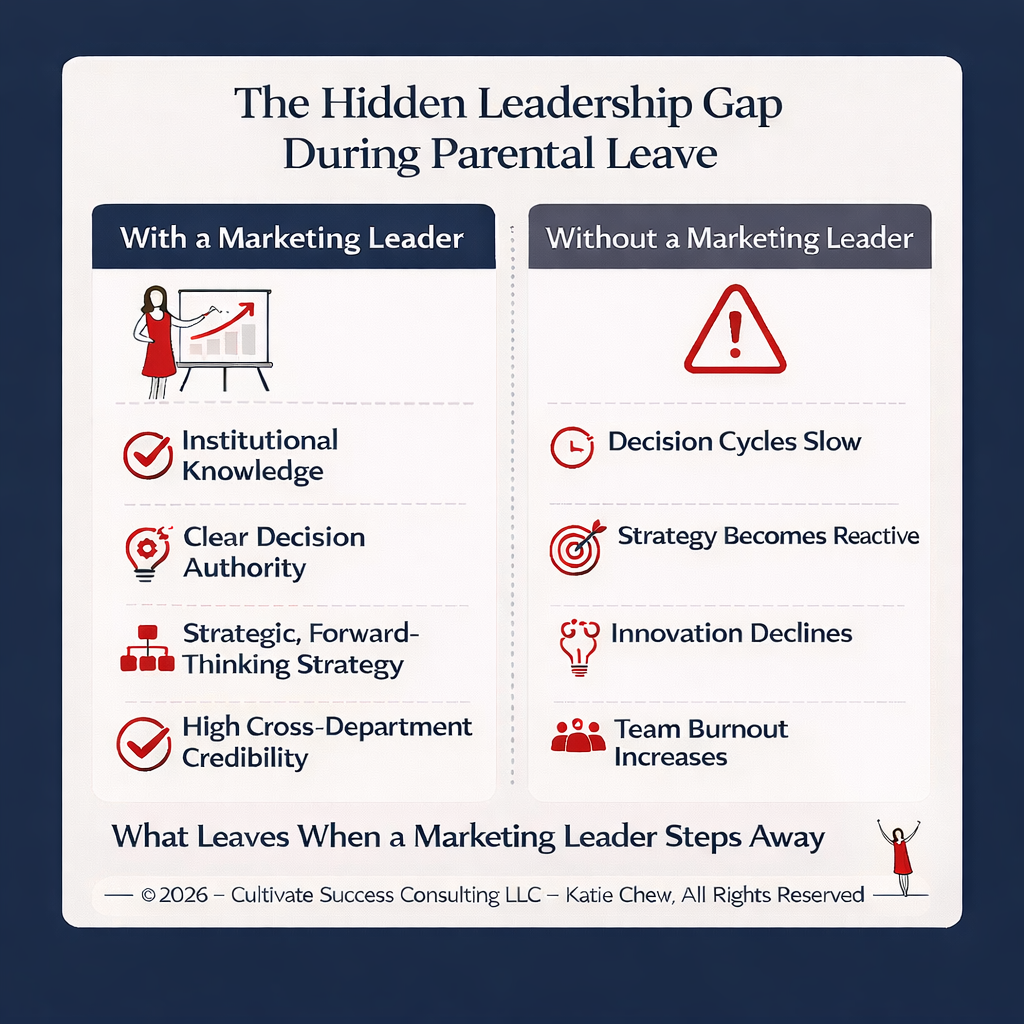
Parental leave doesn’t remove workload capacity alone. It removes strategic leadership from the system.
I’ve seen this inside a Fortune 100 organization, a Fortune 1000 media company, and multiple global agencies. I’ve lived it as the marketing leader responsible for revenue-driving strategy while teams navigated life-altering transitions.
Parental leave is not an HR policy issue. It is a business continuity risk. And most companies are managing it with hope instead of structure.
Planned leave (I’d argue even unplanned leave) is a leadership exposure moment.
And how you handle it determines whether your best people stay.
When Laura Goes on Leave
To understand how this dynamic unfolds, consider a typical scenario.
Laura is the Director of Marketing at a growing company. She oversees a team of fifteen people and manages four direct reports. Her role sits at the intersection of strategy, execution, and leadership communication. She reports directly to the CEO alongside five other senior leaders.
Laura’s influence is not always obvious on an org chart.
But inside the organization, she plays a critical role in maintaining momentum.
She knows which agency recommendations deserve scrutiny and which initiatives are worth accelerating. She has built credibility with the sales team, which means they trust her judgment even when marketing proposes bold changes. She can look at a campaign performance report and immediately recognize patterns that might take others hours to analyze. Over time, Laura has become the person who keeps the marketing organization aligned with revenue goals.
When she announces she will be taking parental leave, leadership responds supportively. They congratulate her and assure her that the team will manage while she is away. Behind the scenes, the coverage plan begins to take shape.
Some responsibilities shift to her direct reports. A senior marketing manager takes ownership of several key campaigns. Another team member manages agency communication. Executive reporting responsibilities rotate among multiple colleagues.
The plan seems comprehensive. But what leaves with Laura is not simply a set of tasks. It is leadership clarity. Very few companies redistribute leadership. And, that distinction matters. Instead of one accountable decision-maker, you now have shared authority or none at all. Instead of confident calls, you get cautious consensus. Instead of proactive positioning, you get preservation.
The Team Experience During the Leave
For the first few months, the marketing team works hard to maintain momentum.
Meetings run slightly longer because decisions require more discussion. Team members double-check their work more frequently because they no longer have Laura’s quick validation. Campaign timelines stretch slightly as priorities compete for attention. No one complains openly. Most people genuinely want to support Laura during this important moment in her life.
But internally, the emotional experience of the team begins to shift. One marketing manager finds herself managing two large initiatives at once. She wants to do a good job, but she is increasingly unsure which projects deserve the most attention.
Another team member quietly absorbs additional responsibilities that were previously handled by Laura. At first, the challenge feels exciting. It is an opportunity to demonstrate leadership potential. But, over time the workload becomes heavier.
Instead of focusing on strategic thinking, team members spend more time simply keeping up with execution. Meanwhile, senior leadership interprets the situation as success. The marketing team appears to be functioning. The dashboards are stable. The organization assumes the system is working.
But the system is not stable. It is stretched.
The Stability Myth
Many leadership teams believe that if they can maintain output until the returning leader comes back, the organization will naturally return to its previous state. This belief is understandable. After all, the leave is temporary.
But modern marketing teams rarely operate with excess capacity. Most are already balancing aggressive growth targets with limited headcount. Asking the team to sustain expanded workloads for several months introduces a form of strain that does not immediately appear in performance metrics. Campaigns continue launching. Revenue continues flowing.
But internally, energy begins to drain. Strategic conversations become shorter and more cautious. Creative exploration declines because team members feel pressure to execute rather than experiment. Employees focus on avoiding mistakes rather than pushing bold initiatives forward.
What appears to be stability is often a fragile equilibrium sustained by prolonged overextension.
And fragile systems eventually reveal their limits.
This is why marketing team parental leave planning requires more than redistributing tasks.
It requires maintaining leadership continuity.
When Laura Returns
Four months later, Laura returns from parental leave.
She is excited to reconnect with her team and resume the work she cares deeply about. At the same time, she is adjusting to a new phase of life that includes sleep deprivation, daycare schedules, and a more structured daily rhythm. Like many returning parents, she arrives with both enthusiasm and quiet apprehension.
She expects to step back into the momentum she helped build. Instead, she walks into a different environment. Her team is exhausted after months of expanded responsibilities and Laura sense the strain her absence caused right away. Several campaigns have drifted from their original strategic direction. Decisions were made without the context she would normally provide. Some of those decisions were perfectly reasonable given the circumstances. Others created complications that Laura now has to unravel.
Instead of resuming leadership in a stable system, she enters recovery mode. Her instinct is to help the team regain its footing as quickly as possible. She works long hours, reviews campaign data late at night, and tries to reassure everyone that things will return to normal.
But something subtle has already changed. Her team associates the previous months with strain. Some team members feel proud of how they stepped up. Others feel quietly burned out. And across the organization, employees are beginning to ask a question that rarely appears in leadership dashboards.
Is this system sustainable?
The Question That Leads to Resignations
Around six to twelve months after a major leadership absence, something interesting often happens. People begin reevaluating their relationship with the organization.
Sometimes the person asking these questions is the returning leader. After experiencing the pressure of rebuilding momentum while adjusting to a new family dynamic, they begin wondering whether their role can realistically support the life they want to build.
Sometimes the person asking the question is the team member who absorbed additional work during the leave. They initially viewed the extra responsibility as an opportunity. Over time, they realized the workload never fully returned to its original level.
And sometimes the person reconsidering their future is a colleague in another department who observed the strain and quietly concluded that the system may be more fragile than it appeared.
When employees begin questioning whether a system is sustainable for the next five years of their lives, departures often follow. Not because of compensation. Not because of benefits.
Because confidence in the system has shifted. This is the hidden cost of poorly managed marketing leadership transitions.
The Financial Reality Leaders Rarely Calculate
When a senior marketing leader leaves an organization, the financial impact can be substantial.
Replacing a Director of Marketing earning $150,000 annually often costs between 1.5 and 2 times their salary once recruitment fees, lost productivity, and ramp time are considered.
Executive search costs alone can represent a significant portion of the expense. Add the months required to fill the role, the disruption to ongoing campaigns, and the time needed for a new leader to fully understand the business, and the cost quickly rises.
For many organizations, the total financial impact reaches $225,000 to $300,000.
And those numbers still exclude the loss of relational capital—agency partnerships, cross-department credibility, and institutional knowledge.
Now compare that with the cost of fractional marketing leadership during parental leave.
Three to six months of structured interim marketing leadership typically costs between $40,000 and $75,000 depending on scope.
That investment maintains strategic direction, protects team energy, and allows the returning leader to step back into a functioning system.
When viewed through this lens, the decision becomes clearer. Leaders are not choosing whether to spend money. They are choosing whether to invest proactively in marketing leadership continuity or pay reactively for turnover.
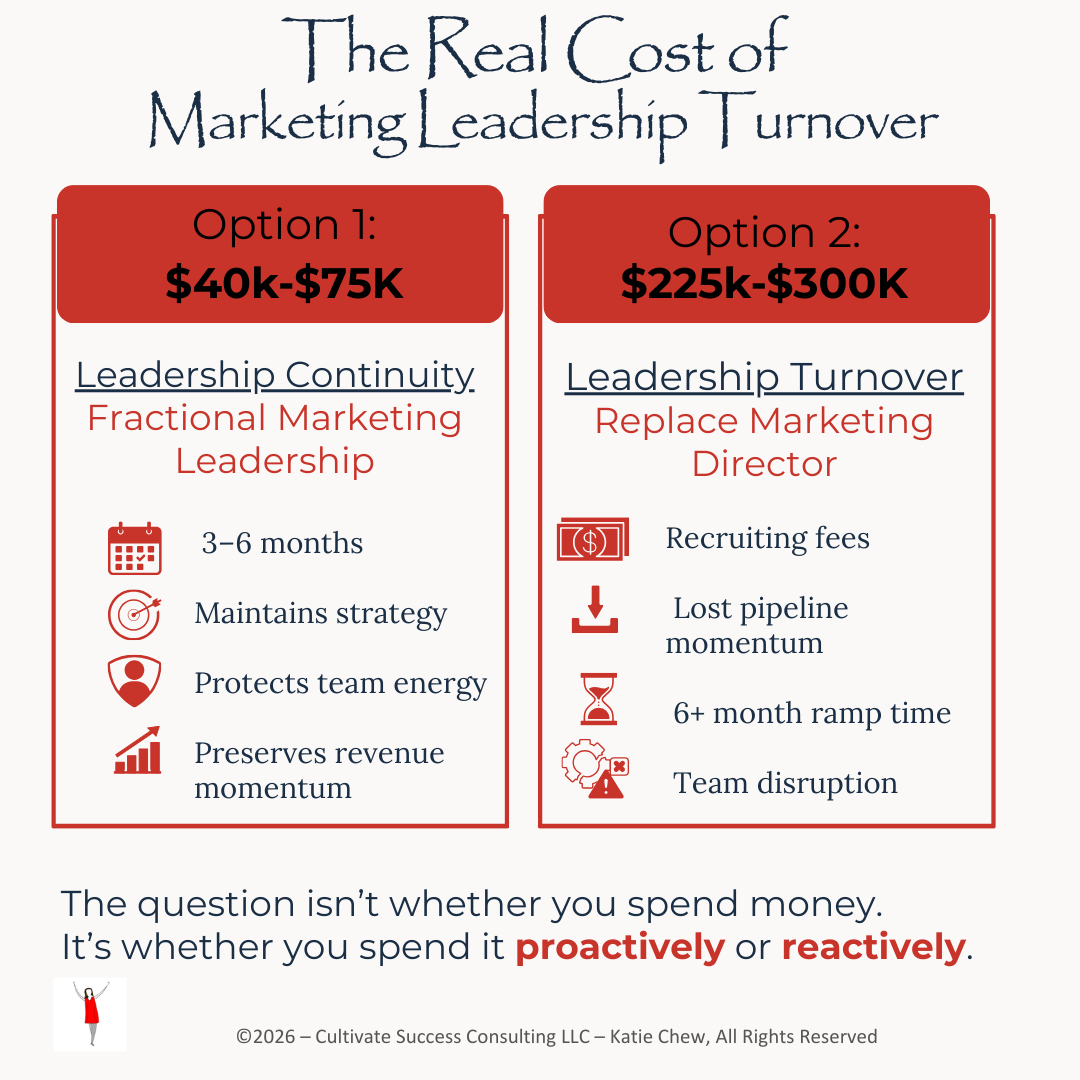
A comparison chart titled 'The Real Cost of Marketing Leadership Turnover.' On the left, a green bar represents Fractional Marketing Leadership (Option 1) costing $40K–$75K, labeled with benefits: Maintains Strategy, Protects Team Energy, Preserves Revenue Momentum. On the right, a red bar represents traditional Marketing Director Turnover (Option 2) costing $225K–$300K, labeled with risks: Recruiting Fees, Lost Pipeline Momentum, 6+ Month Ramp Time, Team Disruption.
How Fractional Leadership Support Parental Leave Coverage
Temporary support often fails because it focuses on execution rather than leadership.
Freelancers can help with content production, analytics, or campaign management. But those roles rarely provide the strategic authority required to maintain direction across an entire marketing organization.
Fractional CMO parental leave coverage works differently.
A fractional leader operates at the same strategic level as the departing marketing executive. They maintain campaign priorities, coordinate with executive leadership, and provide a clear decision-making structure for the team. This continuity stabilizes the entire marketing system.
Team members know where to bring questions and decisions. Cross-department partners maintain consistent communication. Campaigns continue moving forward rather than pausing in uncertainty. Most importantly, when the original leader returns, they step back into a system that still works. Not one that requires rescue.
The Leadership Signal Your System Sends
How an organization handles parental leave sends a powerful signal to employees.
Systems built on sacrifice communicate that sustainability is optional. Teams may admire colleagues who step up during difficult moments, but they also recognize when those moments rely on prolonged overextension.
Systems built on structure communicate something different. They show that leadership has designed the organization to function even when real life interrupts normal operations. That signal matters.
Employees who believe their company has built systems capable of supporting real life are far more likely to remain committed for the long term.
Employees who see fragility often begin exploring alternatives.
This is why maternity leave marketing team coverage should be treated as a strategic leadership decision rather than an operational inconvenience.
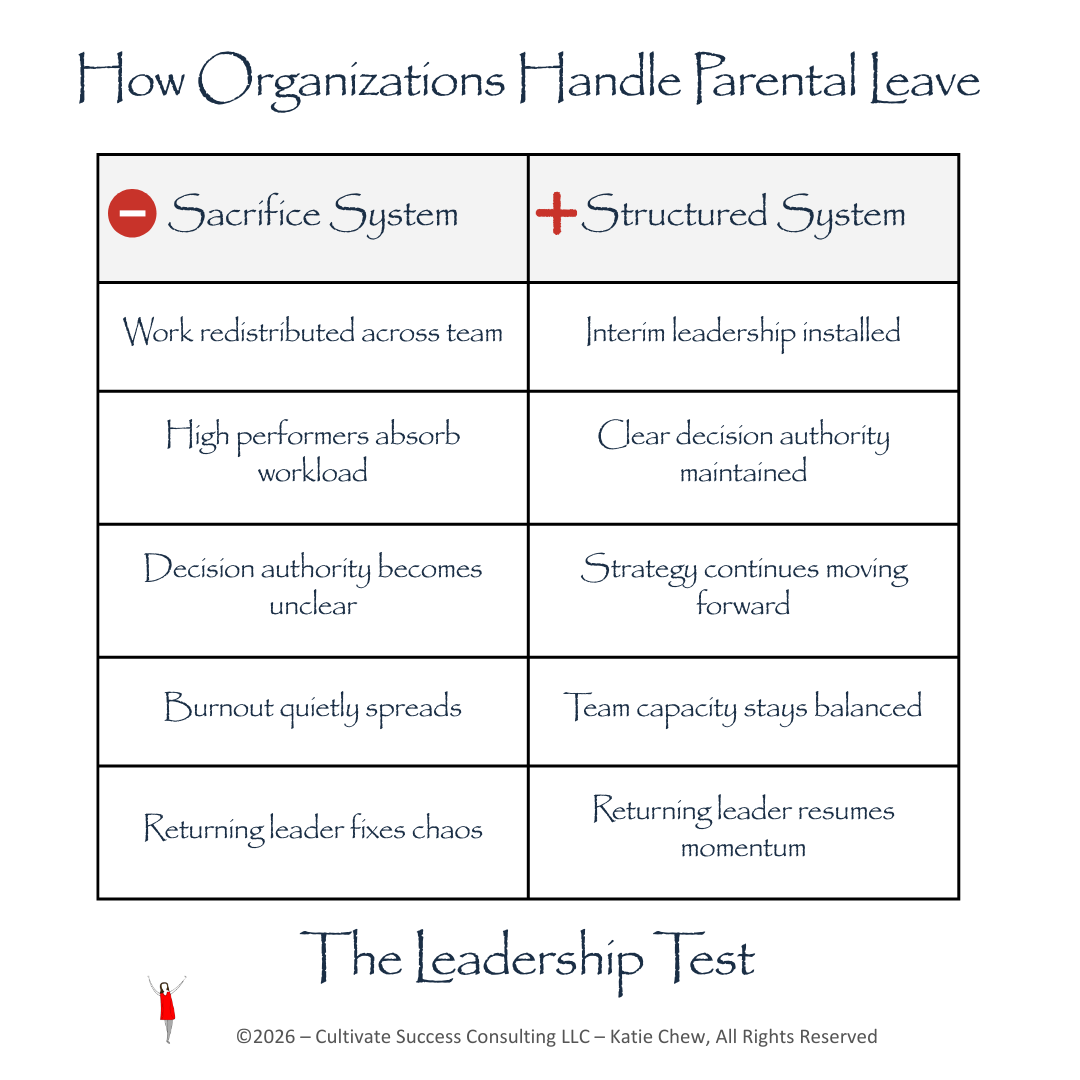
A two-column comparison infographic titled "How Organizations Handle Parental Leave," contrasting a "Sacrifice System" (left) with a "Structured System" (right).
The Real Decision Behind Marketing Leadership Continuity
Parental leave is not simply a scheduling challenge. It is a moment that reveals whether an organization’s systems are resilient or fragile. Companies can attempt to divide responsibilities and hope the strain remains temporary.
Or they can maintain leadership continuity by installing fractional marketing leadership during parental leave. That structure protects strategy, stabilizes teams, and preserves the trust that high-performing organizations depend on. The smaller investment today prevents the much larger cost of turnover tomorrow.
Pressure-Testing Your Leave Strategy
If someone on your marketing team may take parental or medical leave in the next twelve months, now is the time to evaluate your plan.
Ask yourself a few critical questions:
· Who holds final decision authority during the absence?
· How will agency relationships and executive communication be maintained?
· How does the organization support the returning leader’s reentry?
· What signal does the system send to employees about sustainability?
If the answer relies on heroics, the risk is already visible.
Parental leave is not temporary from an organizational perspective. It is a moment that determines whether your strongest people believe they can build their future inside your company. And that belief is worth protecting.
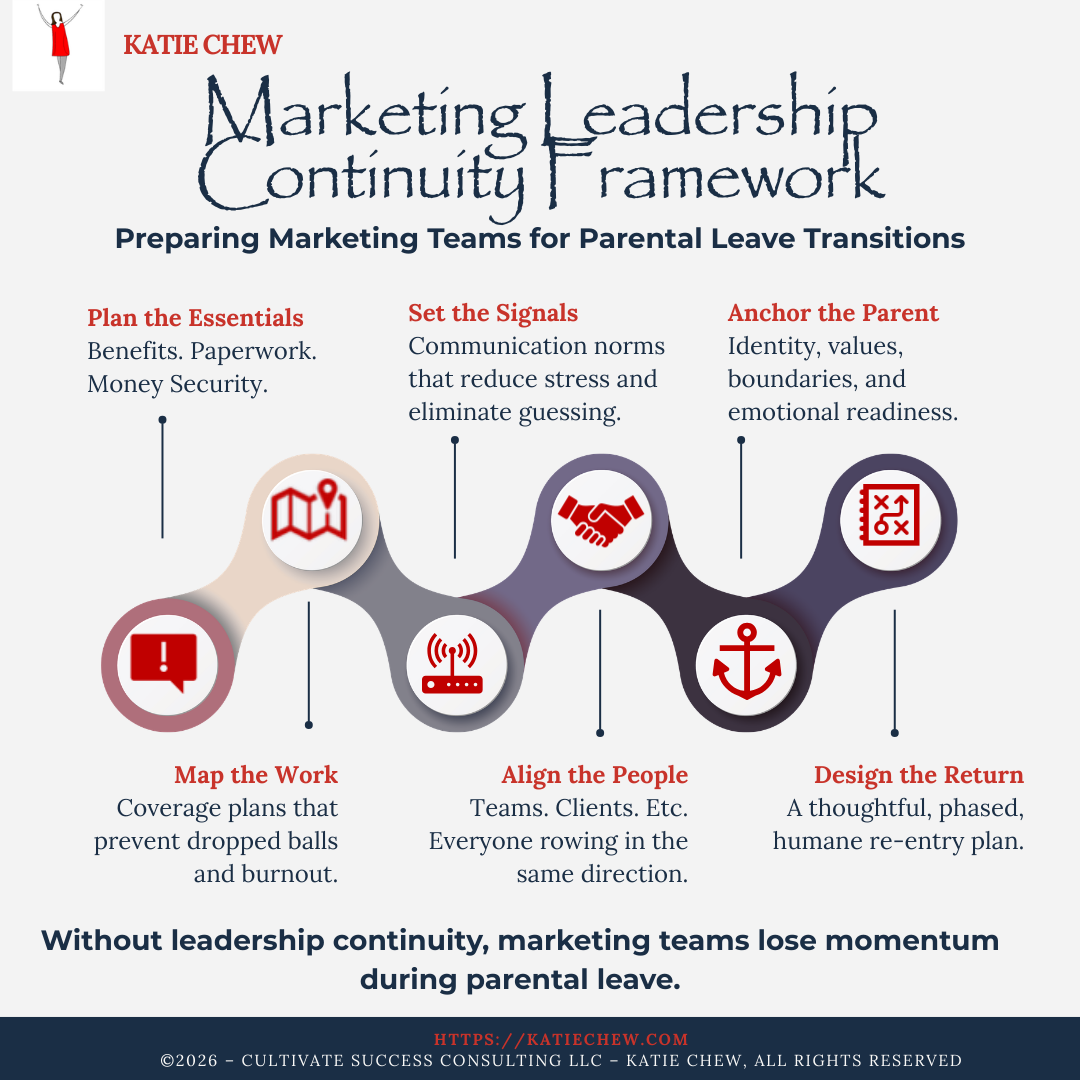
This six-step framework helps marketing teams prepare for parental leave by protecting strategy, aligning stakeholders, and creating a thoughtful return-to-work plan.
If your team has an upcoming parental or medical leave in the next year, let’s pressure-test your plan.
In a strategy call we’ll evaluate:
· Continuity risk
· Financial exposure
· Retention risk
If your system is strong, I’ll tell you.
If it isn’t, we’ll fix it before it becomes expensive.