
Why Your "High-Performance" Marketing Team Is One Absence Away from Burnout
Performance Without Slack Is Not Excellence. It Is Fragility.
The Hidden Tax of Always Being Lean
There is a phrase that gets used a lot in marketing leadership circles. Lean and high-performing. It usually arrives in the same breath as "scrappy," "resourceful," and "agile." Leaders say it with pride. Boards say it with approval. The team itself often wears it like a badge.
It sounds like excellence. It rarely is.
What it describes, in most cases, is a team operating without margin. Every person is fully loaded. Every initiative depends on someone holding context no one else has. Every roadmap assumes everyone shows up, every week, at full capacity, indefinitely.
A team like that is not high-performing. It is highly leveraged. And leverage works in both directions.
When everything is humming, leverage feels like efficiency. When one person is out, even briefly, leverage reveals itself as fragility. The dashboards do not change immediately. The output does not collapse on day one. But the system begins compensating in ways no one tracks until it is too late.
This is the post most marketing leaders need to read before the next pregnancy announcement, surgery scheduling, family emergency, or surprise resignation. Because the moment you find out you are short a person is the moment you find out what your team was actually built on.
Performance Without Slack Is Not Excellence. It Is Fragility.
Slack is not the opposite of performance. Slack is what allows performance to survive contact with reality.
Engineers have a term for this. They call it resilience capacity. It is the difference between a system that runs perfectly under ideal conditions and one that holds when conditions change. Most marketing teams are designed for ideal conditions. They are optimized for full attendance, full energy, and full clarity from every contributor every week.
That is not a team. That is a sprint with no finish line.
A high-performing marketing team has built-in tolerance for variance. It assumes someone will be sick. Someone will take leave. Someone will have a bad week. Someone will leave for another role with two weeks' notice. It plans for those things the way a good supply chain plans for delays, because in both cases, the disruptions are not exceptions. They are the baseline.
When leaders confuse fragility with efficiency, they tend to make the same mistake at the same point in the cycle. They look at a humming team and think the system is working. They cut headcount, defer hiring, or stretch one more campaign onto the roadmap. The team absorbs it. The leader feels validated.
Then someone announces parental leave. Or a key director gets diagnosed with something serious. Or a senior manager accepts an offer no one saw coming. And the system, which had been performing, suddenly cannot.
That is not bad luck. That is the system finally telling you the truth about itself.
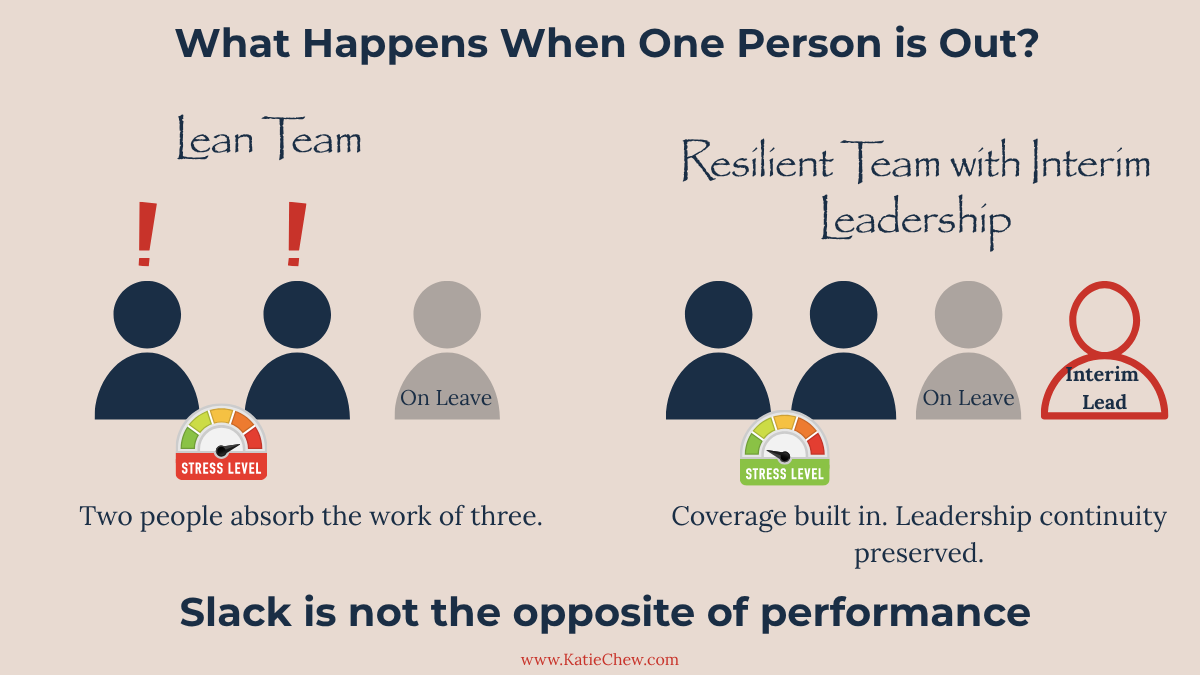
Visual contrasting lean marketing teams slow when one person is absent vs. resilient teams with leadership continuity keep moving.
Hero Culture Is a System Design Problem, Not a Personality Trait
Every fragile team I have worked with has had at least one hero. Sometimes two or three.
You know the profile. The person who never complains about workload. The one who absorbs new responsibilities without flinching. The one who fixes the things no one else noticed were broken. The one whose name comes up in three different meetings as the person who is "just handling it."
Leaders tend to celebrate these people. They get promoted. They get awarded. They get cited as examples of what the culture rewards.
What rarely gets discussed is what their existence means about the system around them.
Hero culture is not a personality trait. It is a system design problem. It is what happens when an organization treats individual extraordinary effort as a renewable resource. The team appears to be functioning. Capacity appears to be sufficient. Leadership appears to be working. None of it is true. What is happening is that one or two people are personally subsidizing the gap between what the team can deliver and what leadership expects it to deliver.
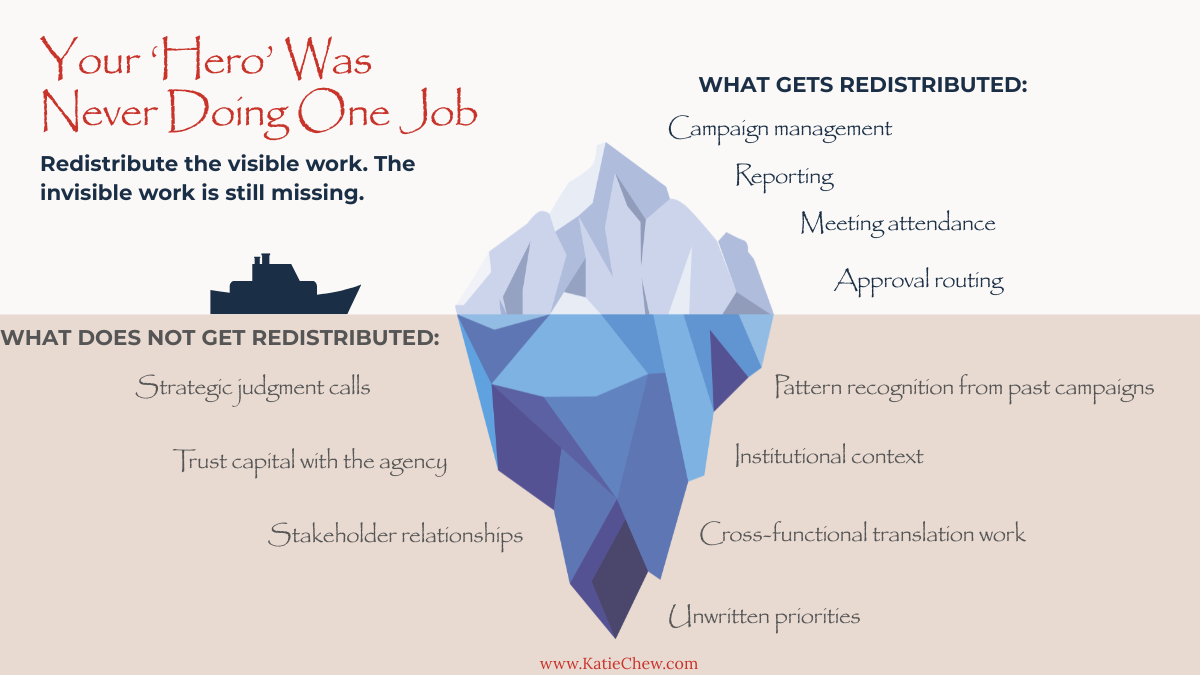
Graphic showing visible marketing work versus invisible leadership work that gets lost when a key person is absent.
That subsidy works until it does not.
When the hero takes leave, the system does not gradually adjust. It cracks. Because heroes were never doing one job. They were doing the visible job, plus the invisible coordination, plus the relationship management, plus the judgment calls no one else had been trained to make. Redistribute the visible job, and the invisible work is still missing. The team feels it immediately. Stakeholders feel it within weeks. Performance feels it within a quarter.
The fix is not to find more heroes. It is to stop building systems that require them.
Why Women-Led Teams Notice This First
There is a pattern I have seen repeatedly in the women-led teams and women-powered organizations I work with. They tend to identify fragility before their peers do. Not because they are more fragile. Because they are paying closer attention.
Women-led teams generally carry a higher cultural literacy around caregiving, accommodation, and the invisible labor that holds organizations together. They are more likely to have first-hand experience with the cost of being the person everyone leans on. They are more likely to recognize the early warning signs of burnout, because they have lived through them. They are more likely to ask whether the system is sustainable, because they have seen what happens when it is not.
This is not weakness. This is signal.
Here is what it looks like in practice. A senior manager in a quarterly planning meeting raises a question about coverage if a key person is out. Half the room treats the question as a distraction from the roadmap. The other half nods, recognizing the same risk but unwilling to be the one who slows the conversation down. That moment is the leading indicator. The team is not asking the question because they are afraid of the work. They are asking because they can see the math no one else is doing out loud.
When a woman-led marketing team raises concerns about coverage, capacity, or what happens during leave, she is usually not catastrophizing. She is reading the room more accurately than the people around her. The instinct to plan for absence is not anxiety. It is operational intelligence shaped by experience.
The teams that listen to that signal build resilient systems early. The teams that dismiss it as worry tend to learn the hard way, often around month four of an absence, when the cracks finally surface in metrics anyone can see.
If your most experienced people are telling you the team feels stretched, that is not a morale issue. That is a continuity warning. Treat it accordingly.
The Compounding Cost of Pretending
Here is what most leadership teams do not understand about burnout. It is not a sudden event. It is a slow, compounding tax that gets paid in pieces nobody connects until the bill arrives all at once.
The first piece is decision speed. When the team is overloaded, decisions slow down. People stop making bold calls because they do not have the bandwidth to defend them if they go wrong. Strategy becomes defensive.
The second piece is creative output. Tired teams produce safer work. Safer work performs predictably worse. Performance dips. Pipeline contribution softens. Leadership starts asking why, which adds more pressure, which produces more cautious work, which performs even less well.
The third piece is institutional memory. Burned-out people forget things. Not because they are careless, but because the cognitive cost of operating at capacity for too long makes context-switching brutal. Mistakes increase. Rework increases. The cost of every project rises.
The fourth piece is attrition, and it is the most expensive. One-third of employees leave within 18 months of returning from parental leave, and 43% of women leave their careers within a year of having a baby. But that pattern is not unique to leave. It applies to any prolonged period where a team has been asked to operate without slack. People do not always leave during the hard period. They leave six months later, when the hard period ends and they finally have the energy to update their LinkedIn.
By the time the resignation arrives, the cost is already locked in. Replacing a Director of Marketing earning $150,000 annually often costs between 1.5 and 2 times their salary once recruitment fees, lost productivity, and ramp time are considered. That is the bill for one departure. Now multiply it by the two or three additional people who watched the spiral and decided they did not want to be next.
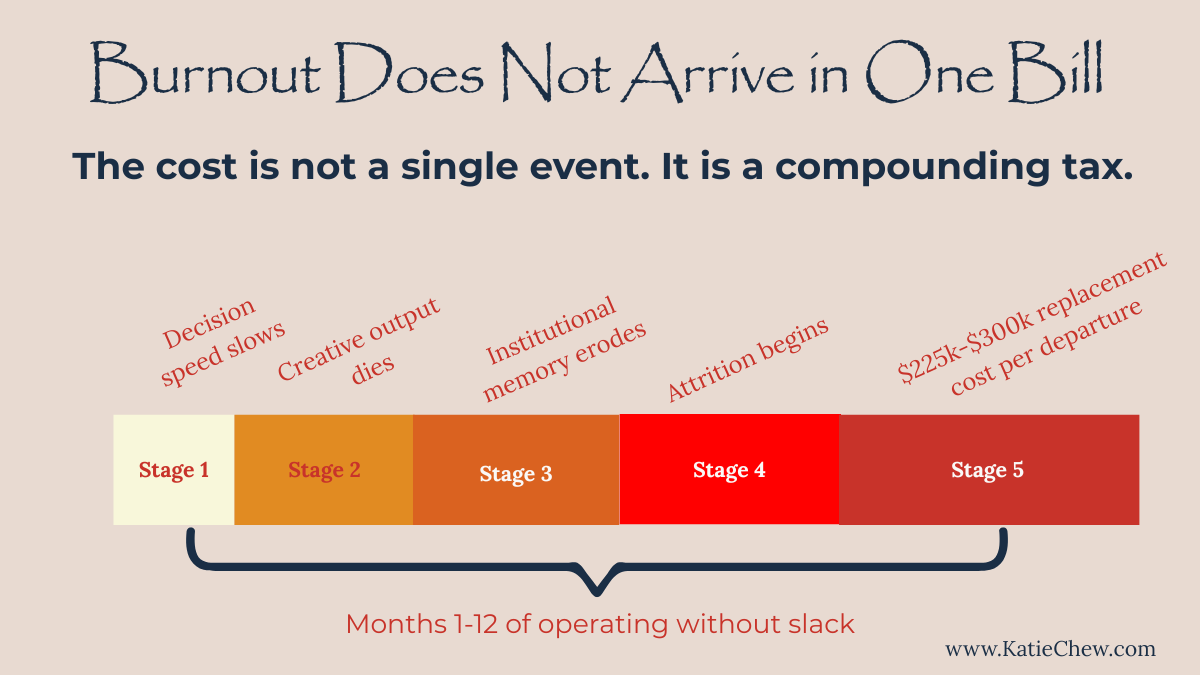
Structural comparison graphic compounding cost of marketing team burnout from slowed decisions to attrition replacement cost.
There is a number that makes this even more uncomfortable. The national average return-to-work rate after parental leave sits at around 57%. Companies that provide structured return-to-work support see that number rise to 90%. The gap between those two figures is not about benefits packages or remote work policies. It is about whether the system someone returns to is one that can hold them. The same logic applies to every other absence.
And this is the part most leadership teams talk around. The cost of fragility shows up as individual departures, but the cause is rarely individual. When three people leave a team within a year, the diagnosis usually focuses on each person's reasons. Compensation. Career growth. A better offer. The pattern across all three is the part that gets ignored. They were operating in the same fragile system. They reached the same conclusion at slightly different times.
What Resilient Marketing Teams Actually Look Like
Resilient teams are not slower. They are not less ambitious. They are not staffed with more people than they need. The difference is structural, not numeric.
Resilient teams design for the assumption that someone will be out. They distribute context, not just tasks. More than one person knows where the campaign brief lives, how the agency relationship works, and why the segmentation strategy was chosen. Decisions are documented in the moment, not reconstructed later.
Resilient teams have explicit ownership for every critical relationship. The agency does not rely on one person to function. The cross-functional partner does not lose their main contact when one calendar invite gets declined. Coverage is named, not implied.
Resilient teams build slack into the roadmap intentionally. Not because they are slow, but because they understand that variance is not optional. A roadmap with no margin is a roadmap that breaks the first time anyone is sick.
Resilient teams treat leave, transitions, and absences as planned events, not emergencies. They have a process. They activate it early. They know who handles what and for how long. The plan is documented before it is needed, which is the only point at which planning is actually useful.
Resilient teams also pay attention to cadence, not just structure. They build sprints with built-in breathing room. They protect focus time the way they protect campaign deadlines. They recognize that a team running at 80% capacity sustainably will outperform a team running at 110% for nine months and recovering for three. Cadence is what makes structure stick. Without it, even the best documented systems collapse the moment urgency overrides discipline.
And resilient teams have a leader who does not romanticize hustle. Who can look at a team that is working hard and ask whether the system is sustainable, not just whether the work is getting done.
What to Look at Inside Your Own Team This Week
If you want a quick read on how fragile your team actually is, do not look at the metrics. Look at what happens when one person is out for two days.
Does the team adjust quickly, or do projects stall?
Do other people know where the work lives, or do they have to ask?
Are decisions still being made, or does everything wait for the absent person to return?
Does the agency or cross-functional partner know who to contact, or does communication break down?
If two days reveal cracks, two months will reveal something more expensive. And six months of someone holding leadership context that no one else has access to will reveal something that takes a year and a quarter of a million dollars to repair.
The good news is that fragility is fixable. The bad news is that it is fixable far more cheaply before the absence than during it.
What to Do Before You Need To
If you can identify yourself in any of the patterns above, the next step is not to overhaul the team. It is to build the structure that should have been there from the beginning, starting with the highest-risk parts of the system.
Map where leadership context actually lives. Identify the relationships that depend on individuals rather than roles. Build documentation for the decisions that currently exist only in someone's head. Plan coverage for the absences you can already see coming, and design contingency for the ones you cannot.
If your team is heading into a planned leave in the next twelve months, this is the window where you still have leverage. Use it.
If you are not sure whether your system is fragile or resilient, the Parental Leave Planning Checklist walks through the diagnostic questions worth answering before the next absence forces you to answer them in real time. If the answers reveal more risk than you are comfortable with, that is the moment a strategy callbecomes worth the time. We will pressure-test your plan, evaluate your continuity risk, and identify where interim marketing leadership can stabilize the system before the cost of fragility becomes visible on a P&L.
P.S.
A team that performs only when everyone is present is not a high-performance team. It is a high-leverage one.
The difference shows up the day someone is out. And by that point, it is no longer a culture question.
It is a math problem.
Sources
Parentaly. Paid Parental Leave Experience for Women in Corporate America (2024). https://www.parentaly.com/resources/parental-leave-experience-survey-2024
Maven Clinic. Four Proven Strategies to Retain Women in the Workforce. https://www.mavenclinic.com/post/women-moms-in-workforce-retention-covid-four-proven-strategies
Maven Clinic. Parental Leave Checklist: A Step-by-Step Guide for Managers. https://www.mavenclinic.com/post/parental-leave-checklist