
Why Leadership Fails During Transitions (And How to Fix It)
The best leaders do not manage work. They manage transitions.
The Moment That Exposes Everything
There is a particular meeting that happens in marketing departments once or twice a year. Someone announces parental leave. Or a director discloses a medical diagnosis. Or a senior manager admits they are burned out and need to step back. Or a VP turns in their notice with two weeks to land the plane.
The room responds the way you would expect. People are supportive. Leadership commits to making it work.
Then the planning starts. Within ten minutes, the conversation has shifted from leadership into logistics. Who picks up the quarterly goals and reporting. Who runs the agency calls. Who covers the executive meetings. The work gets sliced and assigned. The plan looks complete.
That meeting is the moment the transition is most likely to fail. Not because the people in it are careless. Because they have already made the most common mistake leaders make during transitions: they have started solving for tasks instead of leading through change. These are the moments that reveal whether a company actually has leadership—or just operational dependency disguised as leadership.
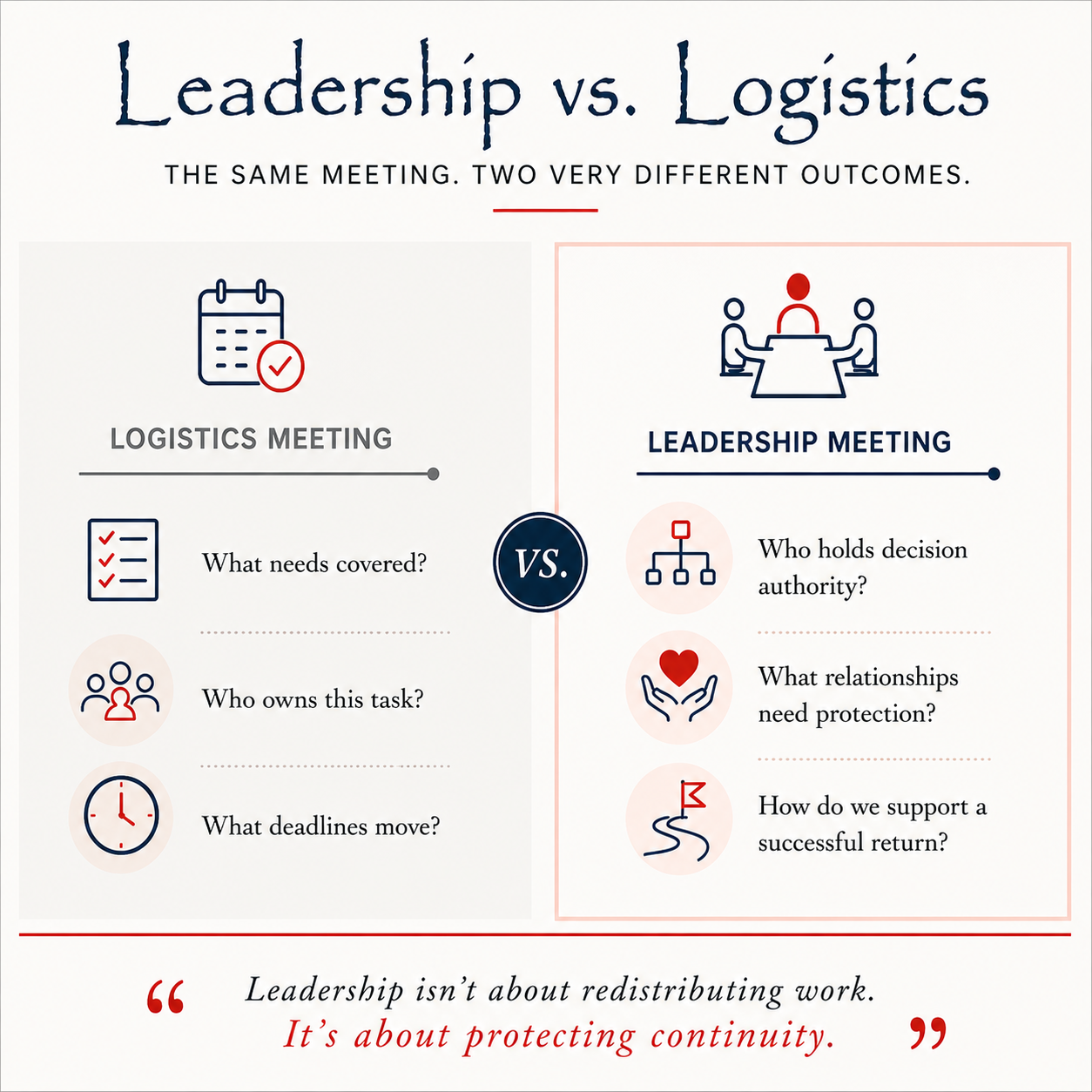
Many organizations focus on covering tasks during leave or leadership transitions. Strong leaders focus on preserving decision-making, relationships, and continuity.
This blog post is about what happens after that meeting. It is about the leadership behaviors that cause transitions to fail, regardless of whether the transition is parental leave, medical leave, a return from burnout, a role expansion, or a leadership exit. The transition type matters less than people think. The leadership behavior matters more than people admit.
The Reframe Most Leaders Need
When transitions break down, the post-mortem focuses on what went wrong operationally. The coverage plan was insufficient. The documentation was incomplete. The agency relationship slipped because no one owned it.
All of that may be true. None of it is the actual problem.
The actual problem is that most leaders manage transitions the way they manage projects. They scope the work, assign the resources, set the deadlines, and assume the system will hold. When it does not hold, they look for execution failures. They rarely look for the leadership failure that preceded the execution failure.
The fact of the matter is: transitions are not projects. They are moments where the system is being asked to operate differently than it normally does, often while a key person is unavailable to make the calls they would normally make. That is not a logistics problem. It is a leadership problem.
Most organizations are not designed to support humans through change. They are designed to extract consistency from people regardless of what season of life they’re in. Leaders who manage transitions well are not better at logistics. They are better at five specific behaviors. The leaders whose transitions fall apart are usually avoiding all five.
Failure Mode One: Treating "Backfilling" as Leadership
Most organizations respond to an upcoming absence by figuring out who will take over the absent person's tasks. They call this "backfilling," and they treat it as if it solves the problem.
It does not.
Backfilling solves for execution. It does not solve for authority. When a senior marketing leader steps away, what leaves is not just a workload. What leaves is decision-making authority, relationship capital, institutional context, and pattern recognition that took years to build. Redistributing the tasks does not redistribute any of those things.
You can see this play out within weeks. The team continues executing because the visible work has been assigned. But decisions slow down because no single person has been given the authority that used to flow through the absent leader. Campaigns hit approval bottlenecks. Cross-functional partners do not know who to call. Strategic questions get tabled because nobody wants to make the wrong call without the leader who normally carries that responsibility. The system has coverage. It does not have leadership.
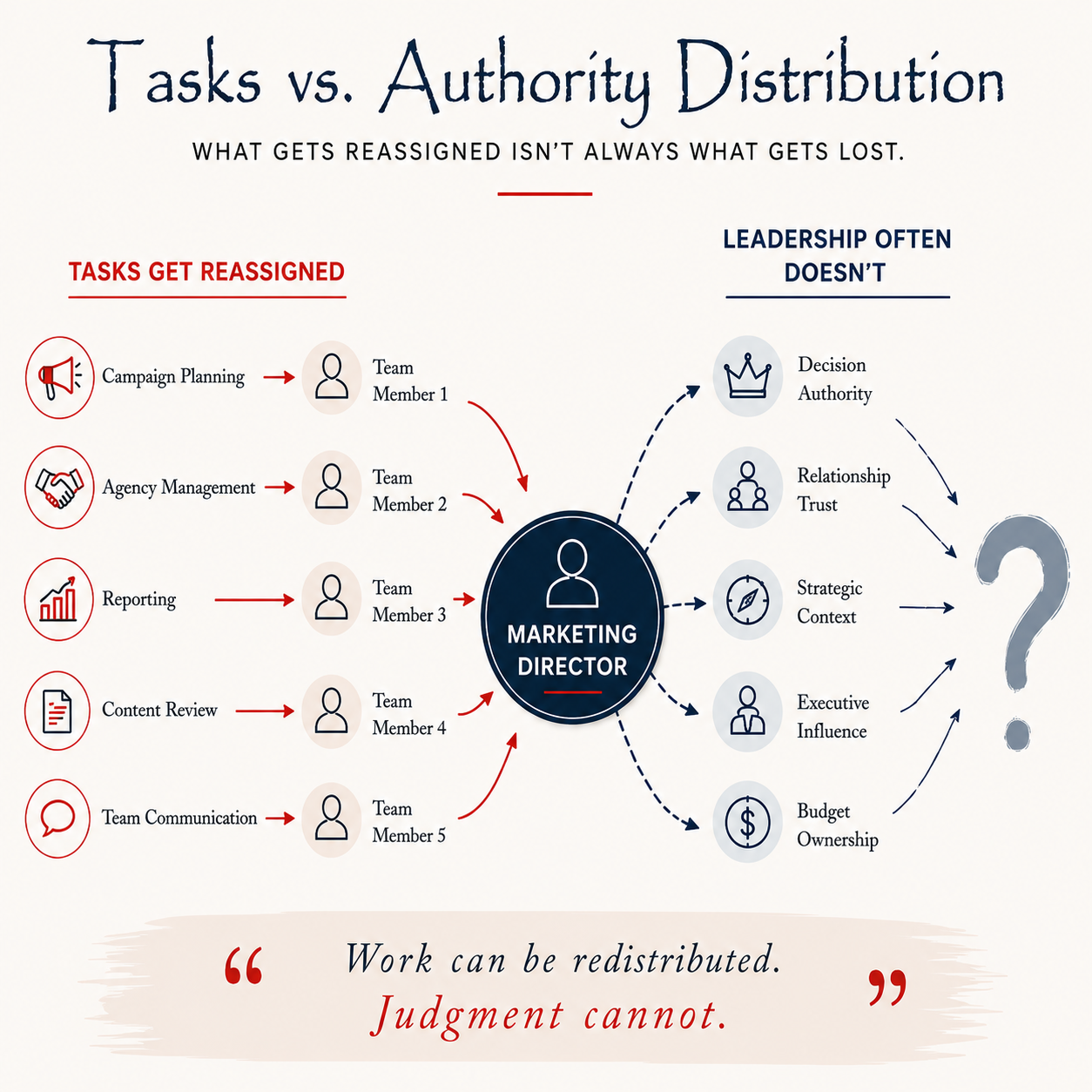
Work can be redistributed. Leadership authority, strategic judgment, and organizational influence are far more difficult to replace during a transition.
The fix is not more documentation. It is naming a single accountable decision-maker for the duration of the absence and giving that person explicit authority. Not implied authority. Not best-effort authority. Documented, communicated, and reinforced authority. That is a leadership act, not a logistics act. Most leaders skip it because it feels uncomfortable to grant power they will eventually need to take back. The discomfort is the price of doing the job.
Failure Mode Two: Pretending People Are Machines
The second behavior is harder to spot, and it shows up across every transition type. Leaders default to talking about the work the absent person does, not the conditions under which the rest of the team will continue doing it. There’s a dangerous belief embedded in modern workplace culture that if someone is competent enough, resilient enough, or loyal enough… they can absorb almost anything temporarily. Temporarily becomes six months. Then a year. Then someone quits. And leadership acts surprised.
This is what happens when a Head of Growth announces parental leave and the conversation immediately turns to which campaigns she will hand off. Or when a Director returns from medical leave and the company assumes she can pick up exactly where she left off. Or when a senior manager returns from burnout and is given the same workload that caused the burnout. The transition is framed around the work, not around the human conditions required to do it. The issue is not that teams are unwilling to step up. Most teams do step up. The issue is that organizations confuse stepping up with sustainable leadership design. They assume:
A redistributed workload equals support
Coverage equals continuity
Productivity equals engagement
Returning to work equals recovering
This is the failure mode most likely to produce delayed resignations. The person performs. The dashboards hold. Six months later, someone resigns and leadership cannot figure out why, because the performance metrics never flashed red. But humans are not machines with interchangeable parts. You cannot remove a strategic leader from an ecosystem and expect the ecosystem to regulate itself indefinitely without support. Especially in environments already operating at maximum capacity. Most teams today are already stretched thin from years of:
Lean staffing models
Constant pivots
Economic uncertainty
Emotional exhaustion
Increased expectations with fewer resources
The reason is that the system was treating people as fungible execution units, and people noticed. They always notice. They may not say it out loud while it is happening. They say it later, with their two-week notice.
The fix is a small set of conversations most leaders avoid because they feel awkward. What is your honest capacity right now? What support do you need? What will the first month back look like, and what should we not assume? These are not soft skills questions. They are continuity questions. The answers determine whether the transition holds or fails.
Failure Mode Three: Avoiding the Conversation Nobody Wants to Have
The third behavior drives the most damage and gets the least attention. Leaders avoid the conversations that would actually prevent the transition from failing.
A senior manager raises a concern about coverage. The room treats it as a distraction. A team member mentions the workload feels unsustainable. The leader thanks them and moves on. An agency partner flags that they do not know who their primary contact is during the leave. The response is a generic "we will figure it out." The signal is being sent. Nobody is listening.
This is not incompetence. It is avoidance. The conversations being skipped are the ones where someone in authority would have to make a call that might upset someone. The call to ask a long-tenured employee to absorb new responsibilities. The call to acknowledge that the team is not actually staffed for what it is being asked to deliver. The call to admit that the returning leader will need more support than the company budgeted for.
Each individual avoidance feels reasonable at the moment. Cumulatively, they are how transitions fail.
I have seen this pattern most clearly in legacy organizations where leadership has lost the habit of confronting performance issues directly. When change is needed, the people pushing for it become the problem in the eyes of leadership, not the underperformers. Senior leadership protects the comfort of the legacy team instead of backing the people driving the change. Culture flows from who leadership protects. Not from training. Not from strategy. From protection patterns.
The same dynamic plays out during every transition. When a leader avoids the hard conversation, they are signaling whose comfort they prioritize. The team reads that signal accurately, and adjusts their long-term commitment accordingly.
Failure Mode Four: Designing for the Departure, Not the Return
The fourth behavior is the one that most often shows up in the data as turnover. Organizations build a coverage plan for the absence. Almost none build a plan for the return.
This is a structural blind spot. Leaders treat the return as the moment when the transition is over. In reality, the return is when the transition is most likely to break. The system has been operating under strain. Decisions have been made without the returning leader's context. Priorities have shifted. The team is tired. And the person returning is also adjusting, often to a new personal reality that did not exist before they left.
If the return is not designed, the returning leader walks into recovery mode. They are expected to ramp back up immediately, while also fixing what drifted while they were out, while also recalibrating to their own changed life. That combination produces the "I came back and everything had changed and nobody told me" experience that precedes most post-leave resignations.
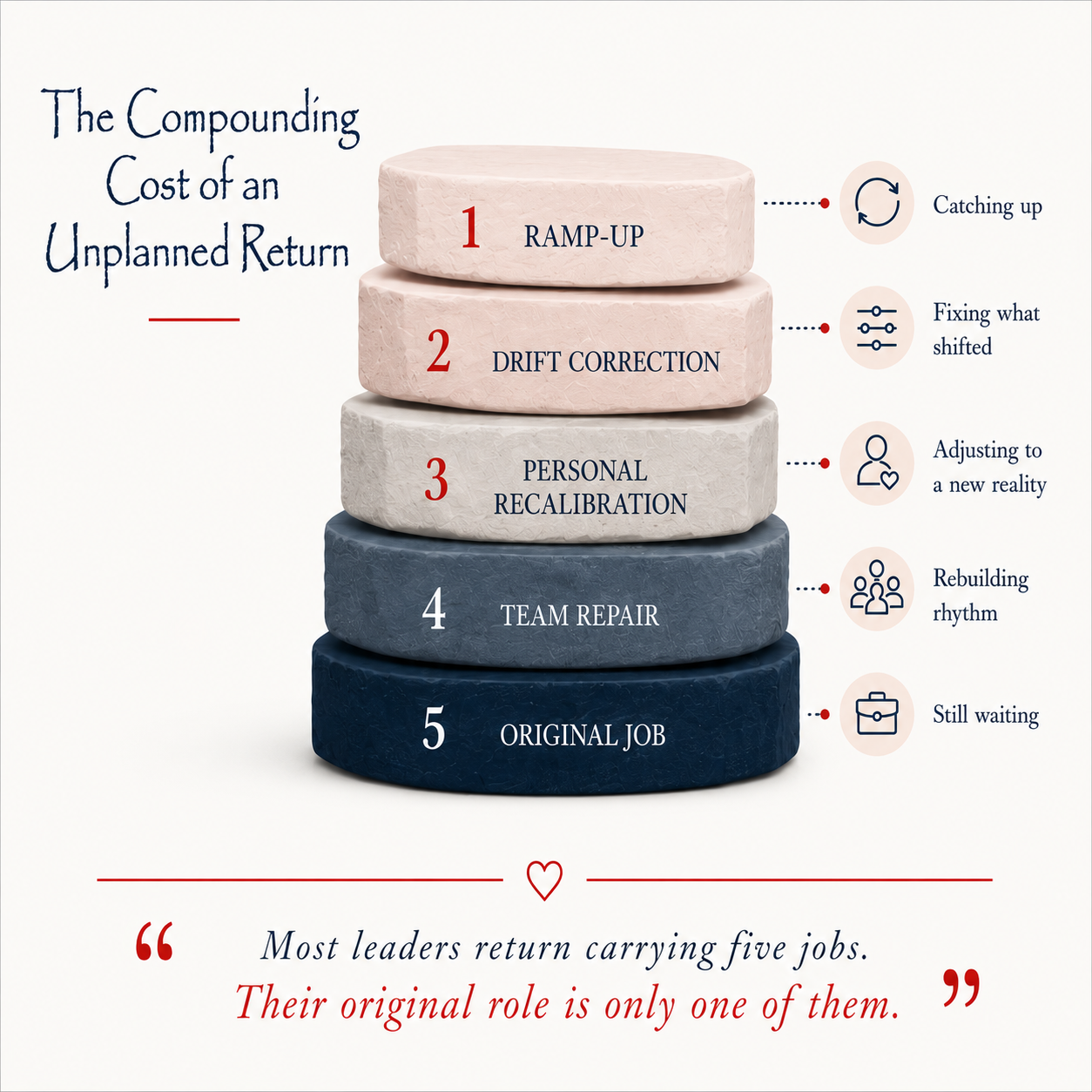
When organizations fail to plan for reintegration, returning leaders often carry multiple competing responsibilities before they can fully resume their original role.
The fix is a designed return: documented updates before the person comes back, a defined first-month scope that is not the full job, structured check-ins at 30, 60, and 90 days, and explicit decisions about what the returning leader should and should not pick up immediately. This is the part of the CONTINUITY Method™ most companies skip because it requires planning months ahead for a moment that feels far away. By the time the moment arrives, it is too late.
Retention is most often won or lost in the first ninety days after a return. Companies that design the return retain the people who go through it. Companies that do not tend to lose them within eighteen months, which is the pattern the parental leave research keeps confirming.
Failure Mode Five: Assuming the System Will Reset on Its Own
The fifth behavior is the most expensive, and it shows up after the transition is technically over. Leaders assume that when the absent person returns, the team will naturally return to its previous state. The strain will release. The workload will redistribute. The system will stabilize.
It will not.
Teams that operate under strain for three to six months develop new patterns. They become more cautious. They stop raising concerns because raising concerns did not work the first time. They protect their bandwidth more aggressively. They start updating their LinkedIn profiles. The strain may release once the leader returns. The patterns the team developed under strain do not release with it. Those patterns become the new normal, and the new normal is more fragile than the old one.
The cost of a poorly managed transition is not measured during the transition. It is measured six to twelve months later, when people who were fine during the leave start resigning, and the diagnosis focuses on each person individually instead of recognizing the pattern.
If three people leave a marketing team within a year of a major transition, that is not three separate stories. It is one structural story being told three times.
Why All of This Matters Beyond Parental Leave
This blog post has used parental leave as the most common example, because it is the most predictable transition most marketing organizations face. The same five failure modes apply to every transition type:
Medical leave breaks the same way parental leave does, often with less notice and more emotional weight on the team.
A return from burnout fails when the company treats the return as the end of the problem rather than the start of the rebuild.
A role expansion fails when leadership assigns the new scope without redesigning the existing one, and the person ends up drowning in both.
A leadership exit fails when the company spends three months recruiting and zero days documenting what the departing leader actually held.
The transition type does not determine whether the transition succeeds. The leadership behavior does. Companies that handle one transition well tend to handle all transitions well. Companies that handle one badly tend to handle all of them badly, for the same reason.
Marketing leadership continuity is not a parental leave problem. It is a leadership maturity problem. It shows up every time the organization is asked to operate without one of its key people.
What This Costs, in Numbers Leaders Actually Track
For a Director of Marketing earning $150,000 annually, the cost of a poorly handled transition is between $225,000 and $300,000 once recruitment, ramp time, and lost productivity are factored in. That number applies to any transition that results in the returning leader leaving, or in a second team member leaving within twelve months.
The cost of handling the transition well, with structured interim marketing leadership, is between $40,000 and $75,000 for three to six months of coverage.
The math is not the interesting part. The interesting part is what most leadership teams do with the math. They run the numbers, agree that the structured approach is cheaper, and default to the redistribution plan anyway. Because the structured approach requires admitting the team is not staffed for the work it is being asked to do. Admitting that is a leadership act. Avoiding it is the failure mode we keep talking about, applied at the budget level.
What to Do Instead
If you can identify yourself or your team in any of the five failure modes, the fix is not a longer checklist. It is a different operating posture during transitions:
Name a single accountable decision-maker for the duration of any absence, and give them explicit authority. Do not split it across three people and call it collaboration.
Have the conversations you are avoiding. Ask the team what they need. Ask the returning leader what the first month should and should not include. Ask the agency partner where they expect communication to break down. Then act on what you hear.
Design the return before the leave begins. Documented updates, scoped first-month responsibilities, structured check-ins at 30, 60, and 90 days. Not a vibe-based reentry.
Watch the patterns six and twelve months after the transition. If you see attrition clusters, look for the structural cause, not the individual reasons.
When you cannot do all of this internally, which is most of the time, bring in interim marketing leadership. Not as extra hands. As a temporary executive who holds the authority while the system stabilizes.
If you have a transition coming up in the next six to twelve months, the Continuity Risk Scorecard walks through the diagnostic questions worth answering now. If the answers reveal more risk than you are comfortable with, a strategy call is the right next step. We will pressure-test your plan, identify which failure modes you are most exposed to, and build the structure that prevents the transition from becoming next year's most expensive line item.
P.S.
The leaders who handle transitions well are not the ones with the best playbooks.
They are the ones willing to have the conversations the playbook cannot have for them.
Everything else is logistics.
Sources
Parentaly. Paid Parental Leave Experience for Women in Corporate America (2024). https://www.parentaly.com/resources/parental-leave-experience-survey-2024