
How to Know If Your Team Can Actually Absorb a Leader’s Leave
A leader announces they will be out for four months.
Maybe it is parental or medical leave. Maybe a resignation creates an unexpected gap while the company searches for a replacement. Maybe a promotion or restructuring means one leader will temporarily carry responsibilities from two roles.
The first instinct is usually the same: look around the team.
Who has room? Who is ready for more responsibility? Who could take the client relationship? Who can run the leadership meeting? Maybe the director can step up. Maybe the leader's direct reports can divide the work. Maybe the executive above them can handle the decisions that are too big to delegate.
Twenty minutes later, the boxes are filled.
It looks like a plan.
But there is a problem with the question leadership just answered.
Availability is not the same as capacity.
Someone can have room on their calendar and still lack the authority to make the decisions the responsibility requires. They can have the expertise but not the institutional context. They can have the context but not the established relationships. They can be capable of stretching for three weeks and completely unsuited to carrying two roles for six months.
That is why the better question is not:
Who can take this?
It is:
What can this person responsibly own, under what conditions, and for how long?
Leadership capacity is the ability to assume responsibility successfully and sustainably, not simply the availability to perform additional work.
Before redistributing a leader's responsibilities, you need to understand the kind of capacity each responsibility actually requires. Only then can you decide whether your existing team can absorb it, whether something needs to change, whether additional support is necessary or whether the work should pause altogether.
That is the difference between assigning coverage and designing continuity.
The Wrong Question Is “Who Has Room?”
When organizations plan for an extended leadership absence or transition, they tend to start with people.
Who could cover?
It is an understandable place to begin. You know your team. You know who is strong. You probably have a few people who have been asking for more responsibility.
But starting with people can lead you to force the work into the capacity you already have rather than determining what the work actually requires.
A marketing director may be perfectly capable of leading the weekly team meeting and approving routine campaign decisions. That does not necessarily mean she should also inherit the VP's executive relationships, annual planning responsibilities, agency negotiations, people leadership and authority over a significant budget.
Those responsibilities do not carry equal weight simply because they all appear on the same job description.
This is one of the distinctions at the heart of my Continuity over Coverage approach.
Coverage asks how to divide the absent leader's work.
Continuity asks what the organization needs in order to keep making good decisions, protect critical relationships, maintain strategic momentum and support the people who remain.
Senior leaders hold far more than visible deliverables. Their roles contain institutional context, decision authority, relationships, pattern recognition and the ability to make tradeoffs when several reasonable priorities are competing with one another.
Redistributing the calendar does not redistribute judgment.
That means capacity cannot be assessed in hours alone.
It has several dimensions.
The Six Capacities to Assess Before Redistributing Leadership Work
To determine whether a team can absorb a leader's responsibilities, assess six dimensions of capacity: workload, decision, context, relationship, leadership and duration.
When I assess whether a team can absorb a leadership absence, I look at all six.
A person does not need to be perfect in every dimension. But the gaps need to be visible before leadership decides that person can own the responsibility.
1. Workload capacity: What is already on their plate?
This is the most obvious capacity, but it is easy to underestimate.
Start with the employee's actual responsibilities, not the theoretical version of their job.
What are they accountable for right now? Which priorities are consuming the most attention? What deadlines fall during the transition? What responsibilities require concentrated thinking rather than simply calendar time?
Then ask the question that matters:
If this responsibility goes on their plate, what comes off?
If the answer is nothing, you have not solved the capacity problem. You have transferred it.
There is evidence behind that concern. Gallup identifies unmanageable workload, unclear communication from managers, lack of manager support and unreasonable time pressure among the workplace conditions most strongly correlated with employee burnout. Gallup also finds that how employees experience their workload matters, not simply the number of hours worked, and points to prioritization and workload management as areas managers can influence.
The useful leadership conclusion is not that people should never be asked to work harder during a transition.
It is that capacity requires tradeoffs.
A strong performer may be capable of taking on substantially more work. That does not tell you whether they should carry it for the duration of the transition while maintaining everything else leadership already expects.
2. Decision capacity: Can they make the calls the responsibility requires?
Workload capacity answers whether someone can do more.
Decision capacity answers whether they can own more.
Suppose a marketing director takes responsibility for the absent VP's media strategy. She understands the campaigns. She knows the agency. She has managed budgets before.
Then performance drops and the agency recommends moving a significant amount of money from one channel to another.
Can she make that decision?
If the answer is, “She'd probably need to check with the CMO,” you need to keep going.
Does the CMO make the call? Does the director recommend and the CMO approve? What threshold can the director authorize independently? What happens if the CMO disagrees? What if the decision needs to be made quickly?
Two of the questions I deliberately separate in leadership transition planning are:
Who owns it?
Who decides?
You cannot evaluate capacity without evaluating authority.
Organizations sometimes give someone responsibility for an outcome while retaining the authority required to produce it.
That is not empowerment.
It is accountability without control.
3. Context capacity: What do they know, and what haven't they had reason to know?
This is where capable people can be unintentionally set up to struggle.
Someone can be excellent at their job and still lack the context required to take on someone else's.
Perhaps the departing leader knows why the organization stopped pursuing a particular customer segment two years ago. She remembers the history behind a difficult agency relationship. She knows the CFO's concerns about the next product launch and which assumptions in the forecast have already been challenged.
None of that may appear in the project plan.
Competence cannot compensate for context someone has never been given.
This is why knowledge transfer before a planned absence should include more than passwords, status documents and recurring meetings.
Ask:
What does the temporary owner need to understand to exercise judgment?
Which past decisions shape the current strategy?
What assumptions are obvious to the departing leader but invisible to everyone else?
Where does institutional knowledge exist primarily in one person's head?
Context capacity can often be built.
But first you have to recognize that it is missing.
4. Relationship capacity: Can trust actually be transferred?
A spreadsheet can reassign a client relationship in seconds.
The relationship itself may take much longer.
Leadership work often depends on credibility with people outside the immediate team: executives, clients, agencies, Sales, Product, Finance, board members or other influential stakeholders.
So ask what the responsibility depends on.
If the temporary owner will need the CFO to approve an unusual investment, does the CFO know who they are? If they are taking over an agency relationship, has the agency seen them operate as a decision-maker? If they will represent Marketing in executive meetings, do the other leaders understand their mandate?
This is one reason transition planning needs to begin before a planned absence whenever possible.
Relationship handoffs require introductions, context and visible sponsorship.
A departing leader saying, “Jordan will handle this while I'm out” is useful.
The executive team treating Jordan's decisions as legitimate is what makes the handoff real.
5. Leadership capacity: Is this a stretch opportunity or a second job?
Leadership transitions can create excellent development opportunities.
Someone gets exposure to executive meetings. A director manages a larger team. A high-potential employee owns a strategic initiative they would not ordinarily lead.
Those opportunities can build capability.
But “development opportunity” can also become convenient language for organizational overload.
There is a difference.
A stretch assignment expands someone's capability. An overload assignment depends on their willingness to absorb organizational understaffing.
Before calling the assignment developmental, ask what support comes with it.
Will their existing responsibilities change? Will they have authority appropriate to the new accountability? Will their manager coach them through unfamiliar situations? Are expectations different because they are temporarily performing at the next level?
Does the arrangement give them meaningful exposure and growth, or merely more meetings, more decisions and more people depending on them?
The goal is not to protect capable employees from challenge.
It is to distinguish intentional development from quietly asking one person to perform two jobs.
6. Duration capacity: How long does this arrangement need to hold?
A workable short-term solution can become a terrible operating model if you run it long enough.
Someone may be able to cover executive reporting for two weeks.
Four months is different.
A team may rally during an unexpected absence and temporarily absorb additional work. If the absence extends, the organization has to reassess rather than treating the team's initial willingness as evidence that the arrangement remains sustainable.
The World Health Organization defines burnout as an occupational phenomenon resulting from chronic workplace stress that has not been successfully managed.
The point here is not to predict that additional work will cause burnout.
It is to recognize that duration changes the capacity calculation.
Ask not only:
Can this work?
Ask:
How long can this work before something needs to change?
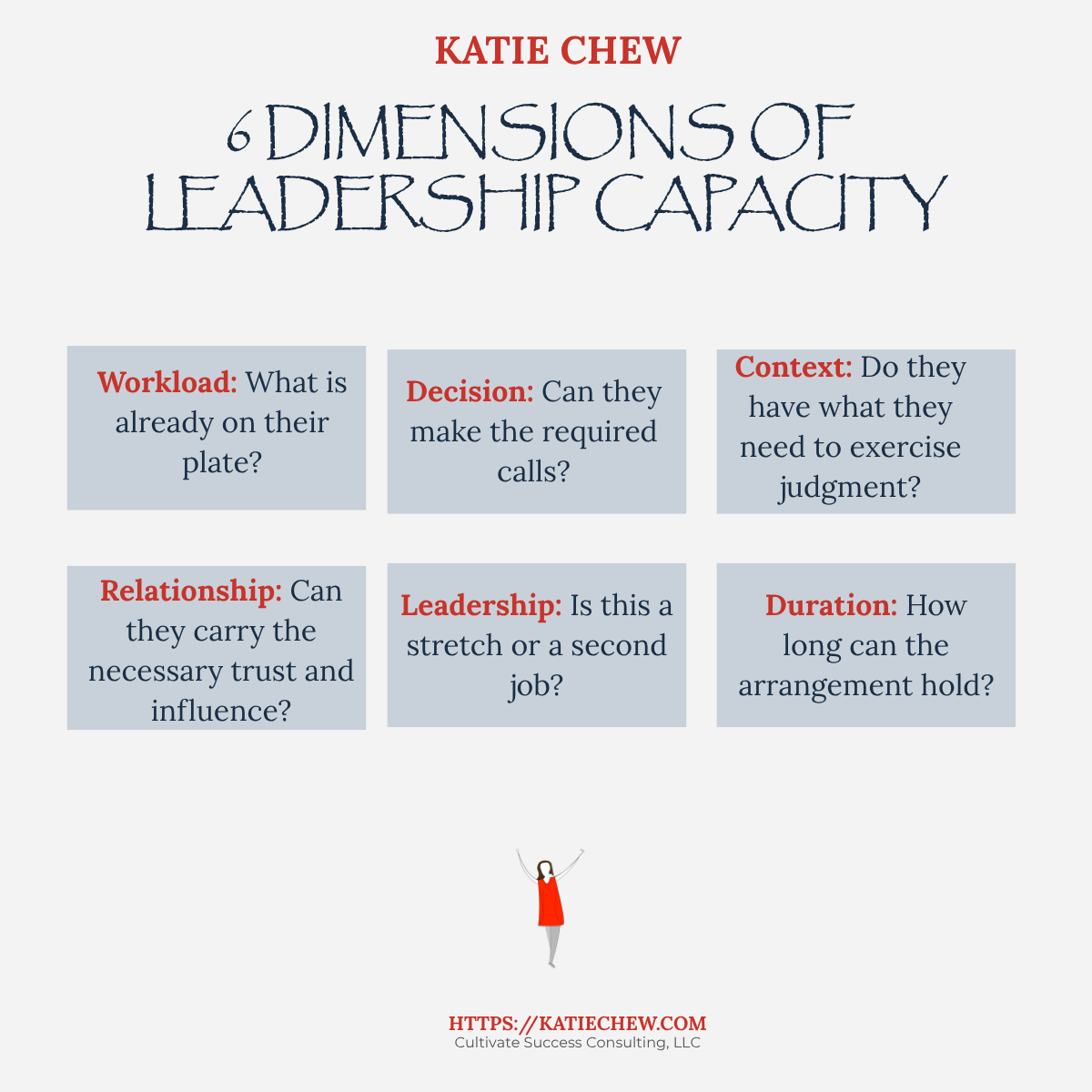
Capacity is more than available hours. Assess all six dimensions before transferring leadership responsibility.
Some Responsibilities Are Heavier Than They Look
There is another mistake hiding inside capacity planning: treating hours as though they tell you how difficult a responsibility is to absorb.
Imagine two responsibilities that each require approximately two hours per week.
One is reviewing a recurring performance dashboard.
The other is representing Marketing in a weekly executive meeting where Product, Sales and Finance regularly negotiate priorities, budgets and launch decisions.
Same time commitment.
Completely different leadership weight.
The second responsibility requires context, influence, judgment, cross-functional credibility and the ability to make or escalate consequential decisions in real time.
This is why the work itself needs to be assessed before you decide who should carry it.
Responsibilities become harder to absorb when they involve:
High strategic complexity or significant consequences if a decision goes wrong.
Critical initiatives with little room for delay.
Multiple cross-functional dependencies.
Institutional knowledge concentrated with the departing leader.
Relationships that depend heavily on established trust.
Frequent judgment calls rather than repeatable processes.
This is part of what I mean by Map the Work, Step 2 of The Continuity Method™.
Mapping the work is not creating a giant inventory of everything the departing leader touches. It is identifying the work, decisions, relationships and dependencies that matter enough to protect, then understanding what each requires before assigning ownership.
Your team may have plenty of capacity for ten routine responsibilities and very little capacity for one strategically critical one.
Hours tell you how much work there is. They do not tell you how much leadership the work requires.
Need to map what actually needs to transfer?
The Leadership Transition Map™ helps you identify the priorities, stakeholders, ownership, decision rights and communication that need to be addressed during a leadership transition.
Download the Leadership Transition Map™ →
Use the Absorb / Adjust / Add / Pause Test
Once you understand the responsibilities and the capacity each one requires, the next decision becomes much easier.
For each responsibility, make one explicit capacity decision: Absorb it within the existing team, Adjust other responsibilities to make room, Add capacity or expertise, or Pause work that does not need to continue.
ABSORB: Can someone realistically take this on as things stand?
Absorb means the responsibility can move to an existing team member without materially compromising their current work, the transferred responsibility or the sustainability of the arrangement.
That person has sufficient capacity, context, authority and capability to own it.
Not every reassignment needs to trigger a staffing change.
If your assessment says the team can absorb the work responsibly, let them.
ADJUST: Could someone own it if something else changed?
This may be the most underused option.
The person is capable of taking the responsibility, but not on top of everything they already own.
So adjust the operating model.
Delay a lower-priority initiative. Reduce the scope of another project. Move routine work elsewhere. Change a deadline. Reassign part of the person's existing responsibilities. Simplify reporting.
If you're adding responsibility to someone's role, be equally clear about what you're taking away.
That is prioritization, not lowered expectations.
ADD: Does the responsibility require capacity or expertise the team does not currently have?
Sometimes the answer is simply that the internal team should not absorb the work.
That does not automatically mean hiring an interim executive.
Additional capacity might come from a contractor, agency partner, temporary internal assignment, project support, specialist consultant or interim leader. The right answer depends on what is missing.
If execution is the gap, add execution.
If specialized expertise is the gap, add expertise.
If strategic judgment, team leadership and cross-functional authority are the gaps, adding another pair of hands probably will not solve them.
The goal is not to buy more capacity indiscriminately.
It is to add the kind of capacity the transition actually requires.
PAUSE: Does this really need to continue?
This is often the hardest decision because organizations accumulate work more easily than they stop it.
But leadership transitions create a useful forcing function.
Does this initiative need to happen this quarter? Does this report still drive a meaningful decision? Does this meeting need to continue? Could this project wait until the leader returns or the permanent role is filled?
One of the five questions I use in leadership transition planning is deceptively simple:
What can safely pause?
Not everything needs to continue during every season.
Deciding what matters most, and giving the organization explicit permission to deprioritize what doesn't, protects capacity for the work that truly requires continuity.
That is not failure.
It is clarity.
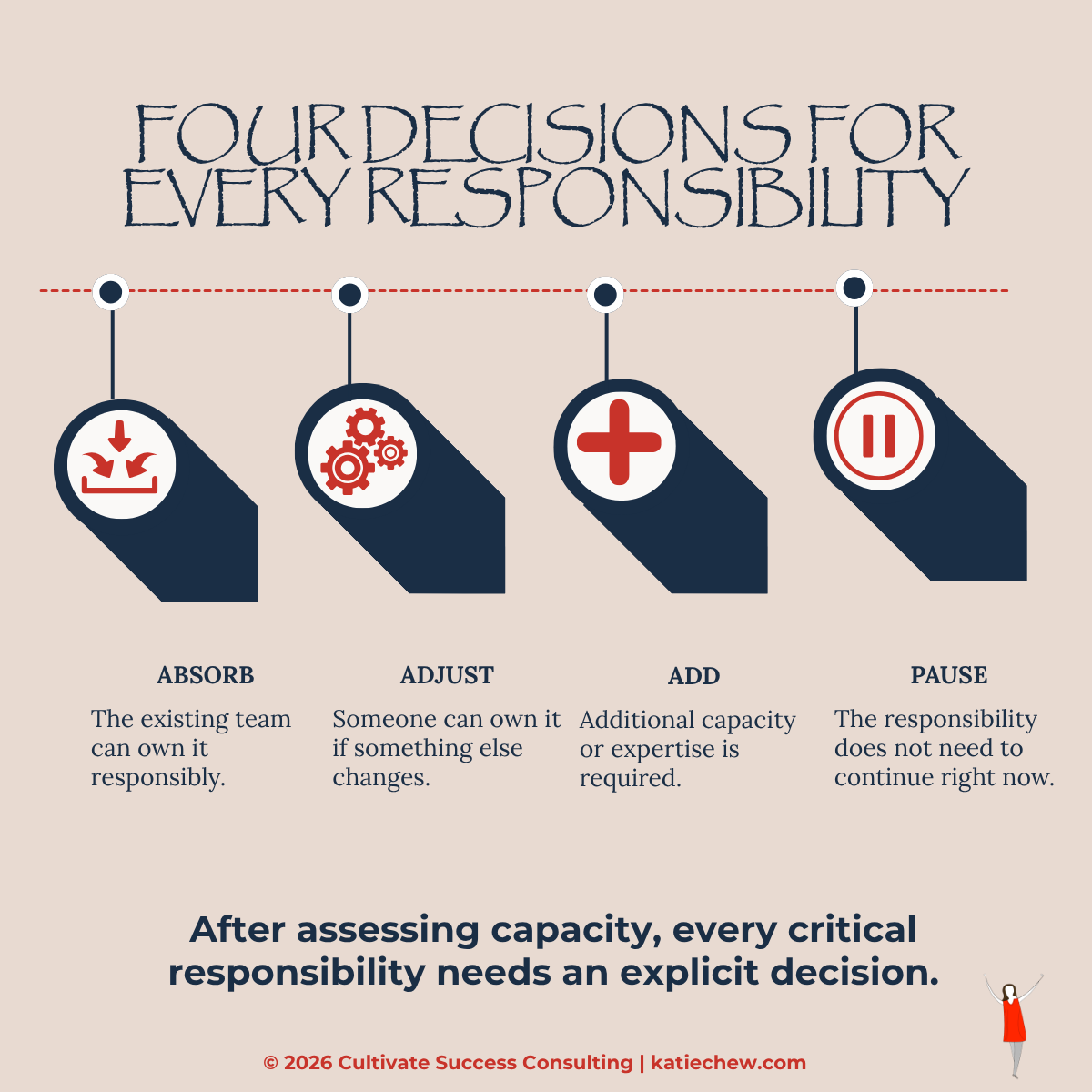
After assessing capacity, every critical responsibility needs an explicit decision: Absorb, Adjust, Add or Pause.
How to Know When Internal Coverage Is Enough
Continuity planning should not become an argument that every leadership transition requires outside help.
It doesn't.
Sometimes the team can absorb the responsibilities.
In fact, a transition can create valuable opportunities to distribute ownership, expose emerging leaders to new responsibilities and reduce unnecessary dependence on one person.
Internal coverage is more likely to be viable when the critical work is clearly prioritized, temporary owners have sufficient capacity and context, decision authority can transfer cleanly, important relationships can be handed off deliberately and existing responsibilities can be adjusted where necessary.
Duration matters too.
A structure that depends on exceptional effort for a few days during an emergency is one thing.
A four-month plan that requires exceptional effort every week is not a plan. It is a bet.
The goal of the assessment is not to manufacture risk.
It is to find out whether the risk actually exists.
If you complete the exercise and conclude, “We're in better shape than we thought,” that is a good outcome. You can move forward with internal coverage with greater confidence because the decision has been pressure-tested rather than assumed.
How to Recognize When Your Capacity Plan Isn't Sustainable
The other possible conclusion is less comfortable.
You may discover that the plan only works because several assumptions about capacity have been left unexamined.
Watch for a few patterns.
Multiple critical responsibilities are accumulating with the same person. New responsibilities are being added without anything being reduced or removed. Temporary owners are accountable for results but still need to escalate many of the decisions required to produce them.
A “development opportunity” is beginning to look like two jobs. The plan depends on sustained extra effort from the people who are already carrying the most. Or an arrangement that looks reasonable for three weeks needs to operate for four months.
None of those automatically means you need external leadership.
They mean you need to reconsider the capacity plan.
This is where leaders need to resist a particularly seductive assumption:
They're a high-performing team. They'll figure it out.
High performers often do figure it out.
For a while.
That is precisely why overload can remain invisible. Work continues. Deadlines get met. People compensate for the system.
Needing additional capacity is not evidence that your team is weak.
It may be evidence that you've finally done the capacity math instead of asking your strongest people to hide it.
Before You Finalize the Plan, Do the Capacity Math
When a leader steps away, the organization temporarily changes.
Pretending otherwise does not preserve continuity.
Good transition planning makes the change explicit.
What matters most? What can pause? Who owns the work? Who has authority? Which relationships need protection? What does the temporary owner need to know? What should change in existing workloads? How long can the arrangement reasonably hold?
Those questions reflect the three leadership principles I use in transition planning: Clarity, Continuity and Communication.
Clarity establishes what matters and what can pause.
Continuity protects the business, the team and the leader by intentionally preserving the work, relationships and momentum that matter.
Communication makes ownership, expectations and escalation paths visible.
The capacity assessment takes that thinking one step further.
For every meaningful responsibility, assess the workload, decision, context, relationship, leadership and duration capacity it requires.
Then decide:
Absorb it. Adjust something. Add capacity. Or pause it.
Sometimes that exercise will confirm that your existing team is ready.
Sometimes it will show that a few targeted adjustments are enough.
And sometimes it will expose a capacity gap that wasn't visible when the conversation began with, “Who has room?”
All three are useful answers.
Before You Assume the Team Can Cover It, Assess the Risk
Team capacity is one part of a larger leadership continuity question:
How prepared is the organization to operate successfully while leadership temporarily changes?
That's what the Continuity Risk Scorecard is designed to assess.
Rather than beginning with a predetermined solution, the Scorecard helps leaders identify where a transition is most vulnerable and what deserves attention before deciding how to address it.
You may discover that the organization is well positioned to manage the transition internally.
You may find a few areas that need attention.
Or you may uncover a gap that requires additional support.
The point of assessing risk isn't to prove you need more support. It's to make the right decision before the transition makes it for you.